Benefits of Co-Living Over Traditional Renting: Everything To Know In 2026
When choosing between co-living and a traditional rental facility, there is nothing to debate, as it is obvious how co-living has evolved in the past few years. It also matters when you know what you are optimising: lower upfront cost, flexibility, or long-term savings.
Surely, in an expensive city, the cost of both can be the same sometimes, but both models solve this problem very differently.
In this article, we have taken a few notes that represent the benefits of co-living. Let us get into it.
Key Takeaways
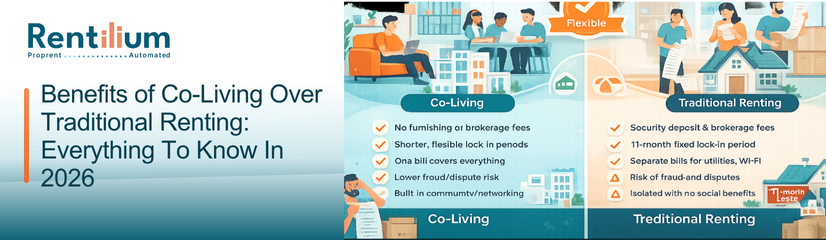
- Co-living eliminates furnishing costs and brokerage fees, which make up the bulk of upfront expenses in a traditional rental.
- Lock-in periods in co-living are typically shorter. Month-to-month or three-month terms are common, versus the standard 11-month lease.
- Utilities, WiFi, and housekeeping are bundled into one rent in co-living, removing the coordination that a traditional rental leaves entirely to the tenant.
- Co-living spaces are professionally managed, which lowers the fraud and dispute risk tied to individual landlords or unregistered brokers.
- Community and networking are built into co-living through shared common areas, which is structurally different from the isolated setup of a private rental.
- Traditional renting still wins on long-term cost once you are past the 12-month mark, since the monthly rent is lower without the co-living service premium.
7 Benefits of Co-Living Over Traditional Renting
When you move to a new city or place, living comfortably matters as much as saving on rent because rent is a consistent monthly expense. That is where co-living helps you simplify the cost of living while offering several additional benefits.
1. Lower Upfront Cost
Traditional rentals come with several initial expenses, including a security deposit, furnishing costs when the house is unfurnished, brokerage fees, and other setup charges. These expenses arise even before you move in.
Co-living removes many of these costs because:
- The room comes with a furnished setup.
- Most operators do not charge brokerage.
- There may be no large deposit requirement.
- The operator takes responsibility for the included amenities.
This is one reason co-living can be a better option when you move to a new city for a short-term assignment.
2. Shorter, More Flexible Lock-In Periods
Traditional rentals commonly follow an 11-month lease. Leaving before the agreed period may require a defined notice period and can involve an early-exit penalty.
Co-living generally offers more flexible commitments. Whether you need a space for one month or a longer period, operators may offer terms that suit students, professionals relocating for work, and people with uncertain job tenures.
3. Everything Bundled Into One Payment
In a traditional rental, you may need to manage rent, electricity, water, WiFi installation, housekeeping, and other living expenses separately. This means multiple bills, vendors, follow-ups, and recurring coordination every month.
Co-living bundles many of these expenses into a single monthly payment made to the operator. This is convenient and removes much of the coordination hassle.
4. Lower Fraud and Dispute Risk
Traditional rentals depend heavily on the credibility of an individual landlord or broker. That is where many rental disputes originate, from unclear deposit terms to fraud involving fake property managers.
Co-living removes the individual landlord from the equation. You deal with a registered operator that manages the property directly, which means accountability rests with a business rather than an unverifiable third party.
5. Built-In Community and Networking
A traditional rental is a private and isolated living arrangement by default. You may not meet your neighbours unless you make a deliberate effort.
Co-living is structured around shared common areas such as lounges, coworking spaces, communal kitchens, and organised events. For someone new to a city, networking and social connection become part of the living arrangement instead of something that must be built from scratch.
6. Move-In Ready, With No Setup Time
Furnishing a traditional rental from scratch with a bed, wardrobe, appliances, and WiFi installation can take weeks and requires capital that many people do not want to spend on a short-term stay.
Co-living rooms are fully set up before you arrive, so you can move in and start working or settling in immediately. For relocations linked to a job start date, the time saved has real value.
7. Where Traditional Renting Still Wins
Co-living is not better in every scenario. Once you are past the 12-month mark, the calculation can shift. A traditional rental's lower monthly rent may begin to outweigh the co-living service premium, especially when you do not use the bundled amenities heavily.
If you are settling in a city for the long term and want to build a permanent, private setup, a traditional rental may remain the more cost-effective choice.
How RentalGini Helps
Choosing between co-living and traditional renting is easier when the listings themselves are reliable. RentalGini removes the guesswork from either path:
- Verified property listings: Both traditional rentals and managed co-living spaces are checked and structured, so you compare accurate information rather than marketing claims.
- Managed living options: RentalGini's managed living services handle day-to-day operations for co-living and PG stays, so support is not dependent on an individual landlord.
- Tenant engagement support: Guided help is available through discovery and booking, so lock-in terms and inclusions are clear before you commit rather than after.
- Maintenance support: Repair and facility requests move through a coordinated workflow, whichever housing model you choose.
Conclusion
Co-living and traditional renting solve the same problem differently. One optimises for flexibility and convenience, while the other optimises for long-term cost.
If you are relocating for work, taking a short-term assignment, or want to avoid furnishing and brokerage overhead, co-living is the stronger choice.
If you are settling in for the long haul, a traditional rental can still win on monthly cost.
Not sure which option fits your situation?
Compare verified co-living and rental options on RentalGini and choose using actual data, not guesswork.
FAQs
Is co-living cheaper than traditional renting?
Co-living has lower upfront costs because furnishing and brokerage are not required, but the monthly rent is usually higher. For stays under a year, co-living tends to be cheaper overall. For longer stays, traditional renting is typically less expensive.
What is the main advantage of co-living over renting a flat?
The biggest advantages are lower upfront costs, shorter lock-in periods, and bundled utilities and services. These benefits reduce the setup time and coordination that traditional renting requires.
Does co-living have a lock-in period like traditional rentals?
Most co-living operators offer shorter lock-ins, often month-to-month or with a three-month minimum, compared with the standard 11-month lease in traditional renting. Confirm the exact terms in writing because they vary by operator.
Is co-living safer than renting from an individual landlord?
Co-living is managed by a registered operator rather than an individual landlord, which generally reduces fraud and dispute risk compared with informal rental arrangements or unverified brokers.
Who benefits most from choosing co-living over a traditional rental?
Working professionals relocating for a new job, remote workers, students, and anyone with a short-term or uncertain tenure benefit most because co-living removes furnishing costs and long lock-in commitments.