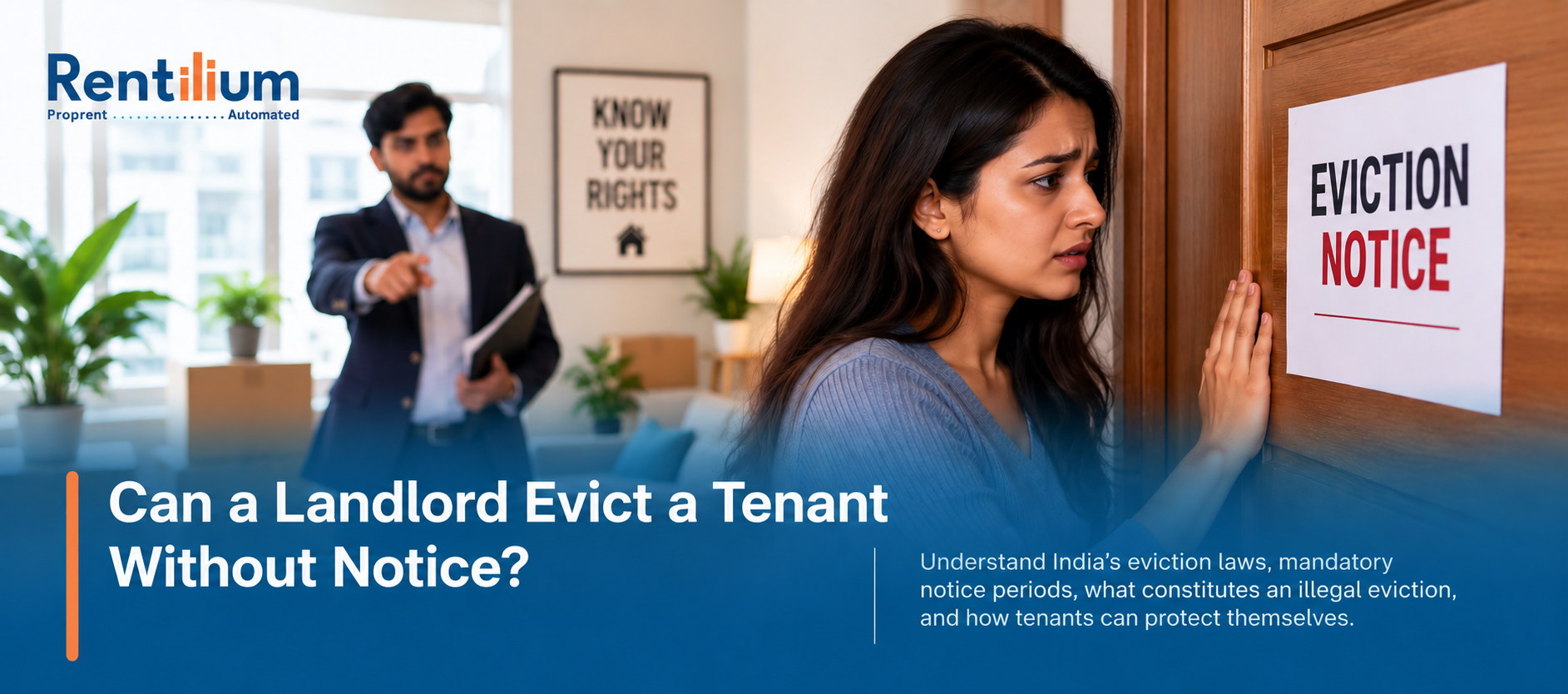
What happens when a tenant loses access to their rented place without missing a single rent payment?[cite: 3] Imagine finding the locks changed, your belongings thrown outside, and a "For Rent" board hung on the door.[cite: 3] Situations like these are a common scenario in the Indian rental market, which raises a question that bothers millions of tenants - can a landlord ask a tenant to vacate the property overnight?[cite: 3]
The answer is no.[cite: 3] India's tenancy laws - the Transfer of Property Act, 1882, the Rent Control Acts, and the Model Tenancy Act, 2021- require landlords to follow due process before eviction.[cite: 3] Courts have declared self-help evictions illegal, no matter how justified the landlord feels.[cite: 3]
This article breaks down what Indian law requires, when exceptions apply, and what tenants can do if they are evicted the wrong way.[cite: 3]
Key Takeaways
- Prior notice is mandatory for eviction.[cite: 3]
- Notice periods vary from state to state.[cite: 3]
- Urgent grounds shorten the notice period, but they do not skip it entirely.[cite: 3]
- Self-help evictions are illegal and can lead to criminal charges against the landlord.[cite: 3]
- Tenants have remedies like police complaints, court injunctions, and possession restoration.[cite: 3]
What Does Indian Law Say About Eviction Notice?
In India, eviction is not governed by one law.[cite: 3] It combines the central law and state-specific ones.[cite: 3] Section 106 of the Transfer of Property Act, 1882 requires a landlord to serve formal notice before terminating a lease, and applies when the rental agreement stays silent in the matter.[cite: 3] Moreover, most states have their own Rent Control Acts which add further protections and often override the Transfer of Property Act's default timelines.[cite: 3]
The central government passed the Model Tenancy Act in August 2021, a template law.[cite: 3] However, it only applies in states that adopt it.[cite: 3] Across all these frameworks, it is clear that a landlord cannot evict as per their will.[cite: 3] There must be a legal ground, a valid notice, and a Rent Authority order.[cite: 3]
The Minimum Notice Period a Landlord Must Give
Under Section 106 of the Transfer of Property Act, the default notice period depends on the nature of the tenancy:[cite: 3]
- A 15-day notice applies to residential or commercial leases.[cite: 3]
- A 6-month notice applies to leases for agricultural or manufacturing purposes, unless specified otherwise in the agreement.[cite: 3]
State Rent Control Acts lengthen notice periods further.[cite: 3] Delhi, Maharashtra, and Karnataka prescribe their own timelines stretching to 30, 60, or 90 days, depending on the eviction ground.[cite: 3] In states that have adopted the Model Tenancy Act, the generic notice period runs around 60 days, funnelled through a Rent Authority.[cite: 3]
As the notice period depends on the state, the tenancy type, and the reason for eviction, the rental agreement and the state Act must be checked before assuming a timeline.[cite: 3]
When Can a Landlord Evict a Tenant Without Prior Notice?
This is what most tenants fear, and the answer is that a landlord never gets to skip notice entirely.[cite: 3] What they can do is decide how short that notice can be.[cite: 3] Under the Model Tenancy Act, recognised grounds for eviction include:[cite: 3]
- Refusal to pay the agreed rent.[cite: 3]
- Non-payment of rent for more than two months.[cite: 3]
- Subletting the property.[cite: 3]
- Parting with possession without the landlord’s consent.[cite: 3]
- Misuse of the premises despite written warnings.[cite: 3]
- Unauthorised structural changes.[cite: 3]
Even here, the landlord must approach the Rent Authority or Rent Court.[cite: 3] The following situations move faster than usual:[cite: 3]
- If the tenant has already vacated the property informally.[cite: 3]
- If the property has been officially condemned as unsafe.[cite: 3]
- If the tenant has denied the landlord's title to the property.[cite: 3]
Genuine emergencies like a building on the verge of collapse are justified.[cite: 3] However, urgency is still decided by a Rent Authority.[cite: 3] Indian law forbids a landlord to walk in, change the locks, and call it done.[cite: 3]
What Counts as an Illegal Eviction?
Indian courts call landlord shortcuts ‘self-help eviction’, and have deemed it unlawful, regardless of how frustrated or justified the landlord may feel.[cite: 3] It includes:[cite: 3]
- Changing the locks.[cite: 3]
- Cutting off water or electricity.[cite: 3]
- Removing a tenant's belongings.[cite: 3]
- Forcing a tenant out through threats or intimidation.[cite: 3]
- Pressuring a tenant to leave without serving a notice period.[cite: 3]
Dispossessing a tenant forcefully can amount to criminal trespass and criminal intimidation under Sections 441 and 506 of the Indian Penal Code.[cite: 3] Skipping the notice-and-order process has real consequences for the landlord, regardless of who was wrong in the dispute.[cite: 3]
What Are a Tenant’s Rights If Evicted Without Notice?
A tenant who has been pressured to leave without completing the due process is not helpless.[cite: 3] Indian law gives them several routes, and courts tend to act faster.[cite: 3] The first step is to file a police complaint.[cite: 3] Since forced eviction counts as criminal trespass or intimidation, the police register a complaint and intervene to help restore possession.[cite: 3]
Furthermore, a tenant can approach a civil court, a Rent Controller, or a Rent Authority to restore possession.[cite: 3] Courts grant urgent interim orders reinstating a tenant before the full case is heard.[cite: 3] In states where the Model Tenancy Act applies, the Rent Authority can order remedies like reinstatement of the tenancy or compensation.[cite: 3]
Tenants can also pursue a civil suit for damages like:[cite: 3]
- Mental distress.[cite: 3]
- Loss or damage to belongings.[cite: 3]
- The cost of alternative accommodation.[cite: 3]
Throughout this process, documentation strengthens their case:[cite: 3]
- Photographs of changed locks.[cite: 3]
- The rental agreement.[cite: 3]
- Rent receipts.[cite: 3]
- Bank transfer records.[cite: 3]
- Any written or message-based threats.[cite: 3]
How Landlords Can Evict Legally - The Right Way to Do It
For landlords, the lawful route to evict a tenant is slower but safer:[cite: 3]
- It starts with identifying a valid legal ground for eviction.[cite: 3]
- Then comes sending a written notice stating the ground for eviction, the property details, and the date by which the tenant must vacate.[cite: 3]
- If the tenant does not comply within that window, the landlord files an eviction petition before the Rent Controller, Rent Authority, or civil court, depending on the state and whether the Model Tenancy Act applies locally.[cite: 3]
- Then, the tenant gets a fair hearing.[cite: 3]
- It is only when the authority is convinced that an eviction order is issued.[cite: 3]
Though a longer road than changing the locks, it is the only one that is reliable.[cite: 3]
Notice Period Comparison by Lease Type
Since eviction law in India is state-specific, the notice period depends on the state and the ground for eviction falls under a state Rent Control Act.[cite: 3] Here is how notice period changes with the specific laws and grounds for eviction:[cite: 3]
| Law / State | Standard Notice Period | Ground | Forum |
|---|---|---|---|
| Transfer of Property Act, 1882[cite: 3] | 15 days / 6 months[cite: 3] | Not specified[cite: 3] | Civil Court[cite: 3] |
| Delhi Rent Control Act, 1958[cite: 3] | 60 days[cite: 3] | Non-payment of rent[cite: 3] | Rent Controller[cite: 3] |
| Maharashtra Rent Control Act, 1999[cite: 3] | 90 days[cite: 3] | Default in rent payment[cite: 3] | Small Causes Court[cite: 3] |
| Karnataka Rent Control Act, 1999[cite: 3] | 30 days[cite: 3] | General grounds[cite: 3] | Rent Tribunal / Court[cite: 3] |
| Model Tenancy Act, 2021[cite: 3] | 60 days[cite: 3] | Non-payment / breach of agreement[cite: 3] | Rent Authority / Court[cite: 3] |
Conclusion
Without the state-by-state variation, Indian law rests on one idea - possession of a rented home can only change hands through notice, a legal ground, and a proper hearing before a Rent Authority.[cite: 3] Though slow, the process was built to stop the more powerful party from forcing the weaker one out.[cite: 3]
Whether you are a landlord trying to recover a property or a tenant trying to hold onto one, understanding this framework is not just a legal formality.[cite: 3] It marks the difference between resolving a dispute and causing a bigger one.[cite: 3]
FAQs
1. Can a landlord evict a tenant without any notice?
No.[cite: 3] Every recognised route to eviction in India requires written notice.[cite: 3]
2. What is the shortest legal notice period in India?
Under Section 106 of the Transfer of Property Act, the default is 15 days for a month-to-month tenancy, but some states allow shorter timelines.[cite: 3]
3. Is changing the locks on a tenant considered legal?
No.[cite: 3] This is a self-help eviction and courts have ruled it unlawful, exposing the landlord to criminal trespass charges.[cite: 3]
4. What should a tenant do first if illegally evicted?
A tenant must file a police complaint, since forced eviction can amount to criminal trespass or intimidation, and follow up with a Rent Authority seeking restoration of possession.[cite: 3]
5. How long does a formal eviction case take in India?
Through a civil court, eviction suits take 1-3 years.[cite: 3] In states that have adopted the Model Tenancy Act, disputes are resolved within 60 days.[cite: 3]