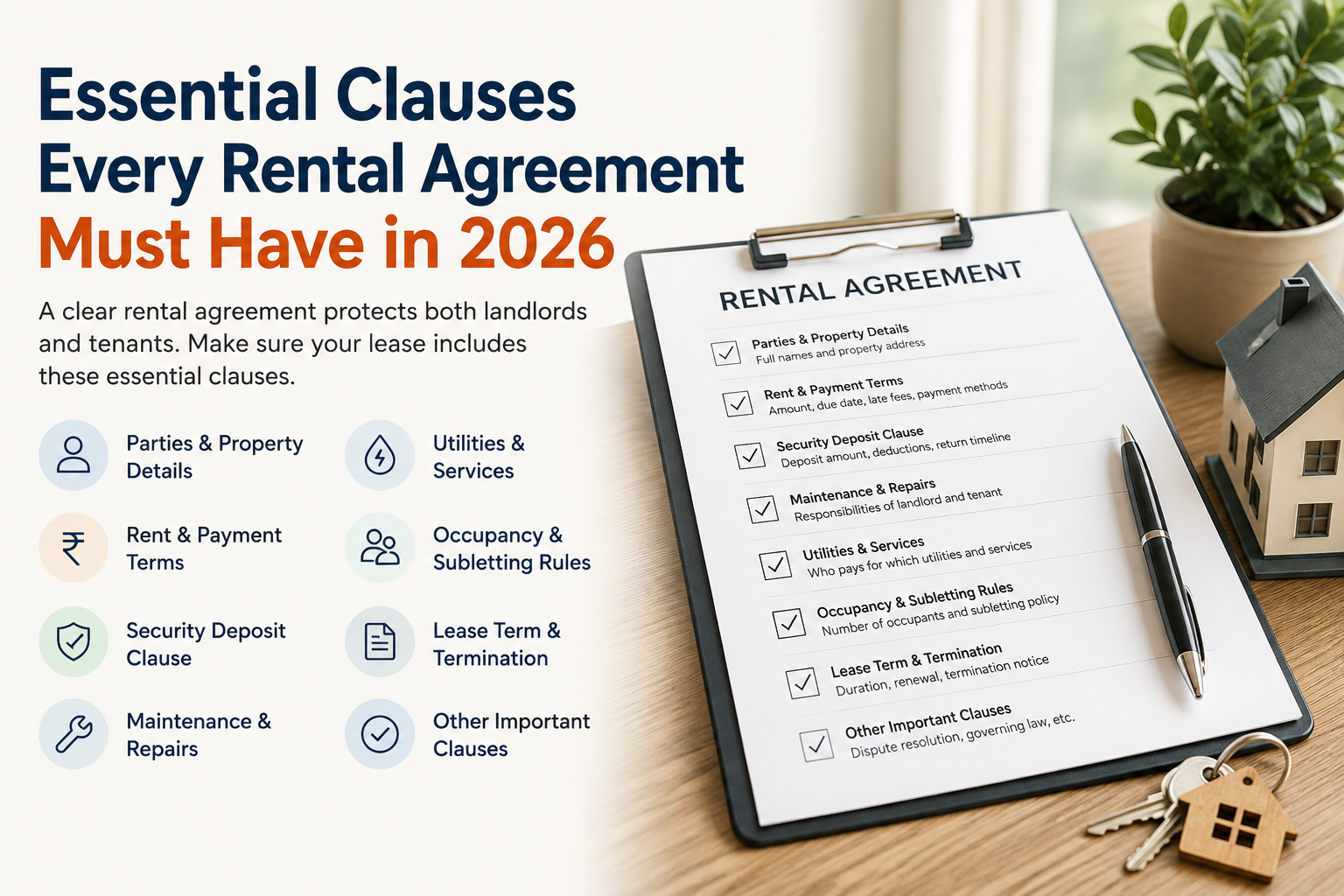
Essential Clauses Every Rental Agreement Must Have in 2026
Written by: Saloni Bhatia
Signing a rental agreement without reading the fine print can cost thousands or even put your home at risk. In 2026, rental agreements are more important than ever as more people choose renting, leases increasingly move online, and landlord-tenant disputes continue to rise.
An outdated or weak rental agreement leaves room for disagreement, confusion, unfair charges, and even improper eviction disputes. That is why every rental contract needs clear, specific, and legally sound clauses.
This guide breaks down the essential clauses that should be considered before signing or renewing a rental agreement in 2026.
What Makes a Rental Agreement Legally Sound?
A handshake deal is not the same as a properly written agreement. Renters and landlords often confuse a lease with a rental agreement, but the distinction can affect their rights and responsibilities.
A lease agreement generally locks both parties into a fixed term, often six to twelve months, while a rental agreement can operate month to month and may be updated with proper notice.
Understanding exactly which type of agreement you are signing is the first step toward creating legally clear expectations.
Core Identification Clauses
Every strong rental agreement should clearly establish who is involved, what property is being rented, and how long the tenancy will continue.
Name of All Parties
The agreement should clearly list the landlord, all tenants, and any co-signers or guarantors using their full legal names. Leaving someone out can make responsibility for unpaid rent or damage much harder to establish later.
Property Description
The agreement should include the exact address, unit number, and anything included with the rental, such as parking, storage, or a garage.
Lease Term
State the exact start and end dates and clearly identify whether the arrangement is fixed-term or month-to-month.
Rent and Payment Terms
Money is where many landlord-tenant relationships break down, so payment terms should leave as little room for interpretation as possible.
Rent Amount & Due Date
Clearly mention the exact monthly rent and a specific due date, rather than using vague wording such as “at the beginning of the month.”
Accepted Payment Methods
Rental contracts should specify accepted payment methods, including bank transfers, digital payments, autopay options, or any other approved method.
Late Fees and Grace Periods
The agreement should clearly state the grace period and the exact late fee that may apply after it, while remaining within applicable local limits.
Rent Increase Clause
A rent increase clause should explain how much advance notice the landlord must provide before raising the rent.
The article notes that notice periods may commonly fall around 30 to 60 days depending on applicable local law.
Where rent-control rules apply, the clause should also reflect any legal limits on how much rent can be increased.
Security Deposit Clause
Security deposits are one of the most common sources of landlord-tenant disputes, which makes this section especially important.
Deposit Amount & State-Mandated Limits
State the exact security deposit amount and ensure that it complies with the limits applicable in the relevant location.
Conditions for Deductions
Clearly list the circumstances in which deductions can be made, such as unpaid rent or damage beyond normal wear and tear.
Timeline & Method for Returning the Deposit
The agreement should explain how and when the deposit will be returned and how any deductions will be itemized.
Interest-Bearing Deposit Requirements
Where local rules require security deposits to be held in interest-bearing accounts, the agreement should clearly address that requirement.
Maintenance & Repair Responsibilities
Repair clauses should clearly explain who is responsible when something breaks and what both parties are expected to do.
Landlord’s Obligations
The landlord should be responsible for maintaining the structure and keeping essential systems such as plumbing, heating, and electricity in a livable condition.
Tenant’s Obligations
Tenants may be responsible for minor upkeep and should report damage promptly so that additional damage does not occur.
Response Time Expectations
The rental contract should set reasonable expectations for responding to repair requests, especially when the issue affects safety or habitability.
Emergency Maintenance Procedures
Define what counts as an emergency, such as a gas leak or burst pipe, and explain how tenants should immediately contact the landlord or property manager.
Utilities & Service Clause
Utility charges can quickly create disputes when the agreement does not clearly explain who pays for what.
The rental agreement should list utilities such as gas, water, electricity, and waste services and state whether each one is included in rent or billed separately.
Modern rentals may also include internet access, smart locks, smart thermostats, or other connected devices. The agreement should specify whether these services are included and who is responsible for maintaining them.
Occupancy & Subletting Rules
Clear occupancy rules help prevent confusion around guests, roommates, and unauthorized tenants.
A strong rental agreement should clearly state the maximum number of occupants allowed in the property and explain whether subletting is permitted.
These limits should remain consistent with applicable housing, safety, and zoning requirements.
Essential Rental Agreement Checklist
- Full legal names of landlord and all tenants
- Complete property address and included facilities
- Exact lease start and end dates
- Monthly rent amount and due date
- Accepted payment methods
- Late fee and grace-period terms
- Rent increase procedure
- Security deposit amount and deduction rules
- Maintenance and repair responsibilities
- Emergency repair procedure
- Utility and service responsibilities
- Occupancy and subletting restrictions
Conclusion
A rental agreement is not simply a formality. It is an important document that protects money, property, responsibilities, and peace of mind for both sides.
Rental laws evolve, markets change, and new issues such as digital payments and smart-home technology continue to reshape what a strong agreement should cover.
Before signing or renewing an agreement, review every clause carefully and consider obtaining advice from a legal professional familiar with the rental laws that apply to the property.