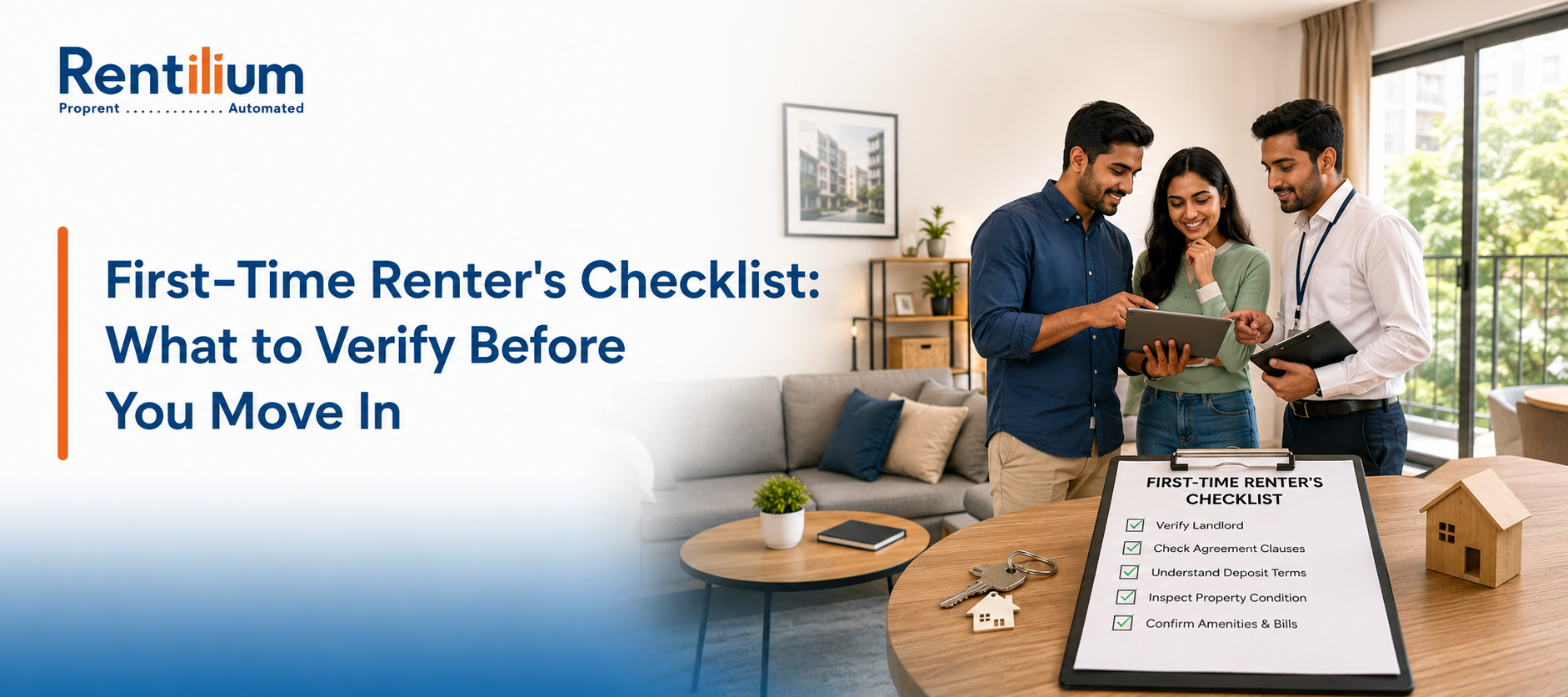
First-Time Renter's Checklist: What to Verify Before You Move In
Written by: Saloni Bhatia
You finally found it - the perfect apartment with a great location, good light, and a rent that you could afford. It’s tempting to sign the lease right away before someone else grabs it. But this is the stage when first-time renters usually make costly mistakes.
Here’s a fact that should slow you down - nearly 1 in 4 renters have lost part or all of their security deposit, often over terms that they never fully understood before signing. As the saying goes, “the devil is in the details” - and the rental agreement is full of them.
This guide breaks down a quite simple and beginner-friendly checklist that covers three things every first-time renter must verify - the rental agreement clauses, the deposit terms, as well as the property condition. A little caution at the initial stage can save a lot of stress later.
Section 1 - Before You Even Look at the Agreement
Before you fall in love with an apartment you’ve seen, just take a minute and step back. Scammers usually have an idea that first-time renters fall for the good-looking apartments quickly, and they use this excitement against you.
As per the National Cyber Crime Reporting Portal (NCRP), people ages 18 to 29 were three times more likely than other adults to report losing money to a rental scam - which is why this section is completely important for you if you’re a first-time renter.
Here are a few things to note before you go anywhere near the agreement.
1. Verify the Landlord or Property Manager is Legitimate
You must never take ownership for granted. You should always ask for proof of ownership (for example, a utility statement or property tax bill) and even verify the person’s ID and see if it matches the name on the documents.
Usually, scammers make use of Craigslist and Facebook Marketplace to post fake listings and target those renters who can’t find housing in their price range.
2. Confirm the Listing Matches Reality
You should never rely upon photos, as they can be old, edited, and stolen from a completely different property. It is even possible that in today’s era, photos can be AI-generated. That is why it’s better to do an in-person visit before paying any amount.
As per research, it is known that laundry, or air conditioners are among the top amenities most often lied about in rental listings. That is why it’s good to check every feature with your own eyes.
3. Ask for the Agreement in Advance
A trustworthy and reliable landlord won’t ever mind sending you the lease draft in order to review calmly at home. However, 70% of the scam victims had already paid a security deposit, 59% paid an application fee, and 50% paid the first month’s rent - all before knowing and realising it was all a scam. That is why you should never let urgency replace due diligence.
4. Bring Someone With More Experience
If you’re renting for the first time, you must bring a parent, an older sibling, or even an experienced friend along with you when you’re on a property visit. It is because a second pair of eyes usually catches the red flags that you might miss at first - like a lease clause hidden in fine print.
As one industry expert put it, “reading your lease carefully” is the single biggest thing that protects your money - not luck.
Section 2 - Rental Agreement Clauses to Verify
Here’s a number that should make you pause before you sign anything - only 37% of renters usually read the entire lease before signing it, while 10% don’t read it at all. This is usually the section where the costly surprises hide. This section usually covers every lease clause that you need to check.
1. Lease Duration & Renewal Terms
You need to know whether you’re signing a fixed term lease (locked for a set period) or a month-to-month agreement (a flexible one, but less stable). Moreover, you also need to check the auto-renewal clause - it is because some leases quietly renew unless you give written notice within a specific window, which traps you for longer than you planned.
2. Rent Details
You must confirm the exact rent amount, the due date, and also the payment methods that are accepted. Do not forget to ask about the late fee policy, as there are certain landlords who also charge a flat fee.
3. Rent Escalation Clause
This is also an important clause that tells you if and how much your rent can increase at the time of renewal. If you fail to check this clause, you might face a sudden jump.
4. Maintenance Responsibilities
Get clarity on who fixes what - is the landlord responsible for plumbing and appliances, or is that on you? There are certain leases that put full responsibility for repairs on the tenant, while others cover just the major appliances. If you have an idea about this in advance, it would prevent any kind of argument over a broken heater during winter months.
5. Subletting & Guest Policy
If you plan to have a roommate, host overnight guests, or even sublet the space later, you need to check the lease first. A lot of landlords usually restrict subletting, as unscreened subtenants carry extra risk and create insurance liability. So, don't assume that this is allowed just because you didn’t read it earlier.
6. Early Termination Clause
Well, life keeps moving, and so do you. Job changes, relationship moves, and other instances. This clause spells out the penalty and the notice period required if you need to break the lease earlier than expected. Skipping this clause is somewhat riskier. Why? Because early termination is the biggest reason renters lose the security money.
7. Pet Policy
Do you have a pet or are you planning to get one? Well, it would be better if you just verify beforehand if it’s allowed or not, or if there’s an extra pet deposit or pet rent. Some apartments or buildings restrict pets, so don’t be under the misconception that your furry friend is automatically welcome.
Quick Tip - Get Clarifications in Writing
If you feel a certain clause is vague or false, you must ask the landlord to verify it - and don’t forget to get that clarification in writing, ideally as an email or lease addendum. The reason behind this is that verbal communications and promises usually are hard to prove later, but written words hold up.
Section 3 - Deposit Terms to Confirm
Your security deposit is usually the biggest chunk of money that you will hand over to your landlord even before moving in - and it is also where a lot of disputes usually happen. More than a quarter of all renters have lost their security deposit at the same point, and 36% of those renters got absolutely no explanation from their landlord at all.
1. Exact Deposit Amount & What it Covers
You should confirm the precise deposit amount in writing, and even clarify whether or not it covers the security only or also includes the last month’s rent. These are probably two different things, and hence mixing them up can leave you confused about how much you actually owe at the time of moving out.
2. Deposit Refund Timeline
Confirm whether or not you would get your deposit back at the time of moving out, and also compare it to your local industry standard timeline. This actually matters more than you think - as only 35% of renters usually receive their security deposit within a week of moving out, so do not assume that it’ll land in your account instantly.
3. Refundable, Adjustable, or Non-Refundable?
Not all deposits work similarly - some deposits are fully refundable, while others allow just partial adjustments, and the rest include a non-refundable portion from day one. You should ask this question clearly before paying, because assuming it's all coming back later can leave you short later.
4. Get a Signed Receipt for Every Payment
You must get a signed receipt for every single payment - deposit, application fee, or rent. This is nothing but just basic protection.
Section 4 - Property Condition Checklist (Before Signing)
| Area to Check | What to Verify |
|---|---|
| Walls & Ceilings | Inspect the property clearly and look for damp patches, cracks, mold spots, or peeling paint. These are not just cosmetic issues but signals a plumbing or a roofing issue that might affect your health and comfort down the line. |
| Flooring | You must check every room for scratches, stains, and also for uneven areas that could be a tripping hazard. If the property comes with uneven flooring, it deserves a second look, as it can point to structural issues. |
| Doors & Windows | Before moving in, you must test that every lock works smoothly, and even check for gaps around the window frames that could let in pests. A door or a window that doesn’t open and close easily is a small annoyance now, but can become a bigger one at times of emergency. |
| Electrical | Flip every switch, test every outlet, and also take a sneak peek at the fuse box to look for any signs of damage or outdated wiring. This is a serious concern that could adversely affect your safety, so don’t skip it. |
| Plumbing | Turn on every tap to check the water pressure, and also look under the sinks for hidden leakages. Moreover, you should also test the hot water function. A slow leak under the sink can quietly cause water damage for weeks before anyone notices. |
Section 5 - Documentation to Request from the Landlord
Here are some of the necessary documents that you must request before you get comfortable:
Copy of the Signed Agreement
It’s always necessary to ask for a physical or a digital copy of the fully signed lease, and not just rely upon the draft upon which you relied earlier. Email a copy to yourself as soon as you receive it, and keep digital backups of it so that you’re able to retrieve it immediately at the time of need.
Inventory Checklist of Existing Furniture & Fixtures
Well, if the furniture is already purchased, then you must request a detailed inventory checklist that has details of every item and also its current condition. It’s essential to be specific here - meaning writing “6-inch scratch on the living room hardwood near the balcony door,” as vague notes often create gray areas later.
Emergency Contact Details
It is so important to have direct contact numbers for your landlord, maintenance staff, and building manager. A burst pipe at midnight is not the time to be searching for a contact number. Just save these contacts as soon as you move in.
Conclusion
Renting your first place should make you feel excited, and not risky. As you’ve read above, nearly 1 in 4 renters lose part of their deposit - usually because something was missed before signing, and not after that. Just don’t treat this checklist as a one-time read. You must keep it handy for every future lease, every negotiation. As one property expert put it, “documentation is your best protection in any dispute.”