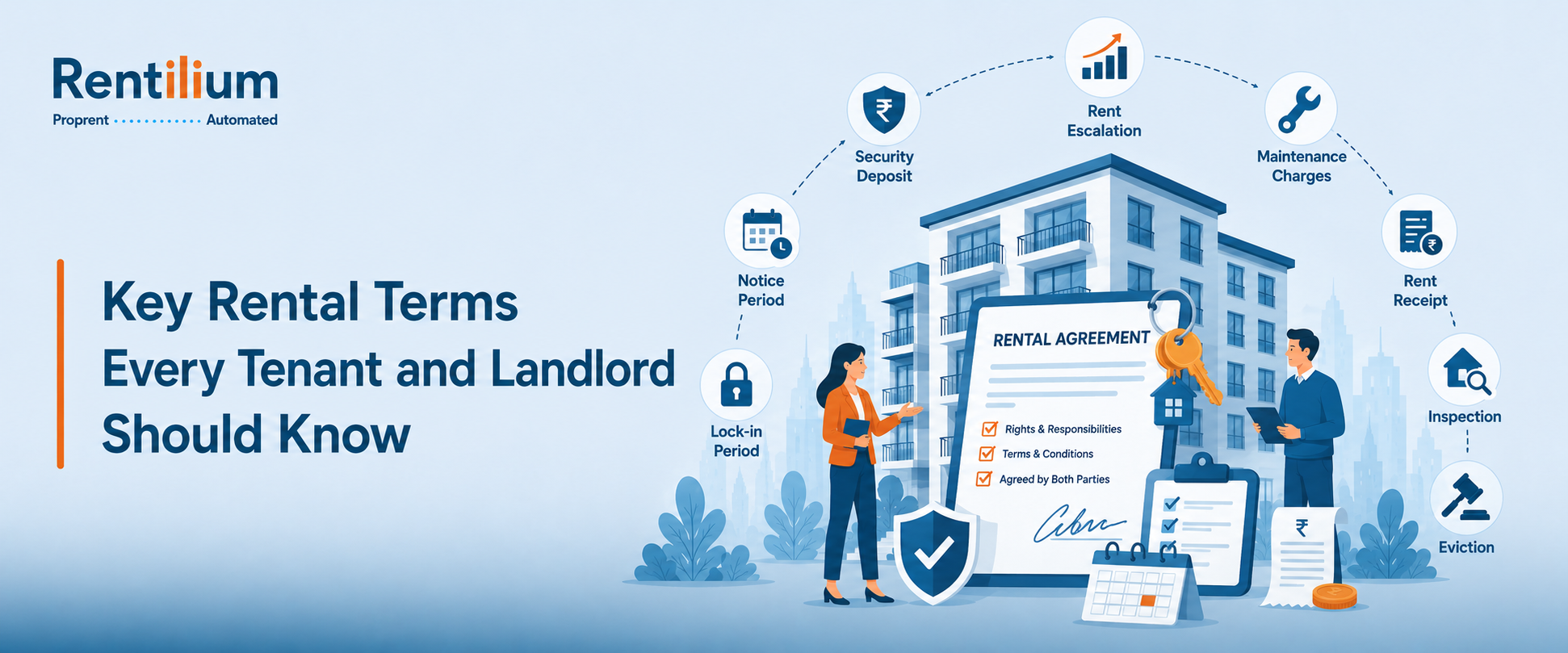
Key Rental Terms Every Tenant and Landlord Should Know
Written By- Aditya Bhople
Most rental disputes don't start with a bad tenant or an unfair landlord. They start with a word nobody bothered to explain. A tenant signs an agreement without knowing what "lock-in period" actually means for them. A landlord mentions "notice period" assuming the tenant already understands it. Weeks later, when someone wants to move out early or rent is overdue, both sides realise they were never really on the same page.
Rental agreements are full of terms that sound familiar but are rarely explained properly, not because anyone is hiding something, but because most people don't ask. And once you've signed something, going back to clarify feels awkward.
This blog is here to make things simpler. Below, we break down the rental terms that tenants and landlords encounter most often, what they mean, why they matter, and how they affect your rights and responsibilities.
Key Takeaways
A rental agreement and a lease agreement aren't always the same. Check the duration and renewal terms.
The security deposit is refundable, not a fee. Get clarity on deductions before signing.
Notice periods and lock-in periods are different, and both should be stated clearly in writing.
If the agreement doesn't mention rent increases, the landlord generally can't raise rent mid-term.
A documented move-in and move-out inspection is one of the best ways to avoid deposit disputes.
1. Rental Agreement vs Lease Agreement
These two get used interchangeably, but they aren't always the same thing. A rental agreement is usually short-term, commonly 11 months in India, and easier to renew or exit. A lease agreement typically runs longer, often a year or more, with stricter terms around renewal and termination.
If your agreement doesn't clearly say which one it is, ask before you sign. It changes how easily either side can walk away.
2. Security Deposit
The security deposit is the amount a tenant pays upfront, separate from rent, and held by the landlord as protection against unpaid rent or property damage. It's meant to be refundable, not a fee and not "extra rent."
Confusion usually happens at the end of the tenancy, when deductions are made without explanation. Ask upfront what the deposit can be used for and what the refund process looks like.
3. Notice Period
The notice period is the advance warning either party must give before ending the tenancy. If a tenant wants to move out, or a landlord wants the property back, this is the minimum time owed to the other side.
It's usually written into the agreement. Thirty and sixty days are both common, but there's no universal standard. Not honouring it is one of the most common sources of disputes.
4. Lock-in Period
Different from the notice period, a lock-in period is a stretch of time, often the first few months of a tenancy, during which neither party can exit the agreement early without a penalty, even with notice.
A tenant who relocates for work during a lock-in period may still owe rent for the remaining months or forfeit part of the deposit. Always check whether your agreement has one and for how long.
5. Rent Escalation Clause
This clause spells out when the rent will increase, usually annually, and by how much. A fixed percentage is common.
Without this clause, a mid-tenancy rent hike is essentially not enforceable because the landlord needs the tenant's agreement to raise it. If your agreement is silent on this, that silence works in the tenant's favour.
6. Maintenance Charges
Separate from rent, maintenance charges cover the upkeep of shared spaces or specific repairs. The agreement should be explicit about who pays what. Some landlords absorb society maintenance into the rent, while others pass it on separately.
Where this isn't spelled out clearly, it becomes a recurring point of friction month after month.
7. Rent Receipt
A rent receipt is a written acknowledgment that rent was paid, usually including the amount, the date, and the period it covers.
Tenants often need these to claim House Rent Allowance (HRA) exemptions during tax filing, so it's worth requesting one every month, even if the landlord doesn't offer it automatically.
8. Move-In and Move-Out Inspection
This is a joint check of the property's condition done together, ideally with photos, once at the start of the tenancy and once at the end.
This single habit prevents more deposit disputes than almost anything else here because it creates a shared, dated record of the property's condition before and after someone lived there.
9. Eviction
Eviction is the legal process by which a landlord can require a tenant to vacate, typically permitted only for specific reasons, such as non-payment of rent or breach of the agreement, and through a defined legal process rather than simply by asking someone to leave.
Tenants have real protections here, and landlords who skip the process expose themselves to legal risk.
Rental Terms at a Glance
| Term | What It Means | Why It Matters |
|---|---|---|
| Rental Agreement vs Lease Agreement | Short-term, often 11 months, vs longer-term contract with different renewal and exit terms | Determines how easily either side can exit |
| Security Deposit | Refundable upfront amount held against unpaid rent or damage | Not a fee. Get clarity on deductions before signing |
| Notice Period | Advance warning either party must give before ending the tenancy | Prevents disputes around sudden move-outs |
| Lock-in Period | Minimum time neither party can exit early without penalty | Can cost rent or deposit if broken |
| Rent Escalation Clause | Terms for if, when, and how much rent increases | No clause means the landlord generally can't hike rent mid-term |
| Maintenance Charges | Costs for upkeep of shared spaces or repairs, separate from rent | Should be clearly assigned to avoid monthly friction |
| Rent Receipt | Written proof of rent paid, with amount, date, and period | Needed for HRA tax exemption claims |
| Move-In/Move-Out Inspection | Joint, documented check of property condition | Best safeguard against deposit disputes |
| Eviction | Legal process to require a tenant to vacate | Must follow due process, not a verbal ask to leave |
Conclusion
Rental terms are easy to overlook when both sides are focused on moving in, collecting rent, or completing paperwork. But understanding the meaning of each term before signing can prevent confusion later.
Whether you're a tenant or a landlord, the safest approach is to make important terms such as notice periods, lock-in periods, deposits, rent increases, maintenance responsibilities, and property condition records clear in writing from the beginning.
FAQs
1. Is a rental agreement legally valid without registration?
It depends on the duration and the state you're in. Many short-term agreements, commonly 11 months, are kept unregistered in practice, but rules and consequences vary by state, so check local requirements rather than assuming.
2. Can a landlord deduct the entire deposit for normal wear and tear?
Generally, no. Deductions should cover damage beyond normal use or unpaid dues, not everyday ageing of paint or fittings. This is why a documented move-in condition matters.
3. What happens if I break the lock-in period?
It depends entirely on what's written in your agreement. Some specify a penalty, often part of the deposit or a set number of months' rent, while others are silent, leaving it to be worked out directly between both parties.
4. Do I need a rent receipt if I pay rent by bank transfer?
Yes. A bank transfer shows money moved, but a rent receipt confirms what it was for and which period it covers. It's still the standard document required for HRA claims.
5. Who decides the notice period if the agreement doesn't mention one?
If it isn't specified, there's no automatically implied timeframe, and it becomes a grey area best resolved by mutual understanding, which is exactly why it should be written into the agreement in the first place.