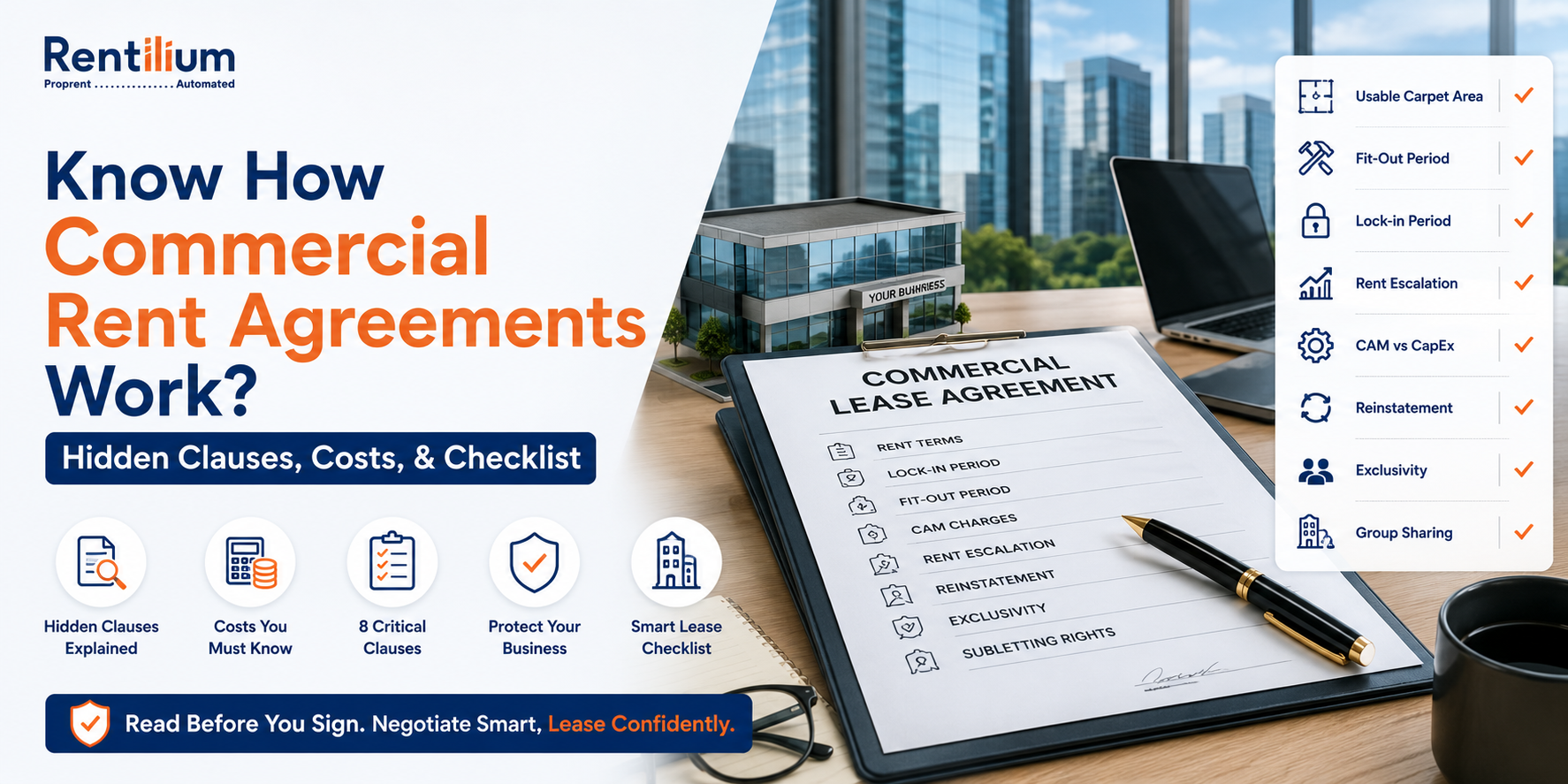
Know How Commercial Rent Agreements Work? Hidden Clauses, Costs, & Checklist
Written by: Saloni Jain
You find the right commercial space. The foot traffic looks good, the location makes sense, and you are already imagining desks, signage, interiors, and customers walking in.
Then the landlord places a multi-page lease agreement in front of you. Checking only the rent and security deposit can be a costly mistake.
A vague clause can leave a business paying for unusable common areas, expensive fit-outs, large maintenance obligations, or years of rent after the branch stops making financial sense.
Commercial vs Residential Leases: What’s the Core Difference?
Longer Commitments
The article notes that residential agreements are often much shorter, while commercial leases may run for 3 to 9 years and can include legally binding lock-in clauses.
Heavy Fit-Out Capital
Commercial tenants may invest significantly in HVAC, wiring, partitions, lighting, interiors, and other business-specific improvements.
Complex Operational Expenses
Shared utilities, elevators, generators, security, and common areas can create separate Common Area Maintenance or CAM charges.
Registration Requirements
The article states that commercial leases exceeding 11 months should be formally registered.
8 Critical Clauses That Make or Break Your Lease
| Clause | Core Risk to Mitigate |
|---|---|
| Usable Carpet vs Built-up Area | Paying premium rent for corridors, lift lobbies, and other unusable common spaces |
| Fit-Out Period | Paying rent while interior construction is still underway |
| Lock-in Period | Remaining financially trapped in an underperforming branch |
| Rent Escalation | Rent increases that grow faster than business revenue |
| CAM vs CapEx | Paying for landlord asset upgrades disguised as maintenance |
| Reinstatement | High costs to demolish quality fit-outs on exit |
| Exclusivity | Direct competitors opening in the same building or complex |
| Group Entity Sharing | Penalties when restructuring, sharing desks, or using the premises through related entities |
1. Usable Carpet Area vs Super Built-up Area
One common mistake is assuming that the area quoted by the landlord is the area the business can actually use.
Super built-up area can include a share of common lobbies, corridors, staircases, and lift areas.
Before agreeing to the rent, ask for the carpet area and a floor plan so you understand what portion of the premises is actually usable.
2. The Fit-Out Rent-Free Window
A bare commercial space may need substantial work before the business can begin operating.
- Negotiate a 30 to 90-day rent-free fit-out period
- Define when Base Rent actually starts
- Clarify utility consumption payable during the fit-out phase
3. Lock-in Period vs Notice Period
A lock-in period can restrict both parties from exiting the lease early without financial consequences.
The article gives an example of a landlord requesting a three-year lock-in, which could leave a tenant responsible for remaining rent even if the business stops performing.
One suggested negotiation approach in the article is a shorter 12-month lock-in followed by a standard 2 to 3-month written notice period.
4. Rent Escalation Terms
The article notes that commercial rent escalation commonly ranges from 5% to 15% every three years.
- Clarify the exact escalation percentage
- Make sure the increase applies to Base Rent only if that is the agreed structure
- Avoid unclear compounding escalation formulas
5. Common Area Maintenance (CAM) & Hidden CapEx
CAM is one of the areas where operational costs can become difficult to understand if the lease is vague.
Typical CAM Items
- Lobby cleaning
- Security staff
- Common area electricity
- Backup generator fuel
Landlord Asset Obligations Mentioned in Article
- Central HVAC replacement
- Structural waterproofing
- Elevator overhaul
- Exterior painting
6. Debranding vs Reinstatement Obligations
Many commercial leases require tenants to restore the premises to their original condition before leaving.
This can become expensive when the tenant has invested heavily in flooring, lighting, partitions, electrical work, or interiors.
Before signing, clearly define whether the tenant must remove only furniture, equipment, branding, and movable items or whether major demolition will also be required.
7. Exclusivity & Non-Compete Clauses
For gyms, cafes, restaurants, clinics, diagnostic centres, and similar businesses, the identity of neighbouring businesses can be commercially important.
The article suggests negotiating a clause that restricts the landlord from leasing nearby units to direct competitors where this matters to the tenant's business.
8. Intra-Group Sharing and Subletting
Businesses can expand, restructure, create subsidiaries, or launch new divisions during a long lease.
The agreement should therefore clarify whether related group entities can use the same premises and whether subletting or desk sharing will trigger additional charges or approvals.
Taxes, Stamp Duty, and Registration
Mandatory Registration
The article states that leases exceeding 11 months should be registered with the local registrar under the applicable registration framework.
Stamp Duty Sharing
The article notes an industry convention of splitting stamp duty and registration costs between landlord and tenant.
TDS & GST
The supplied article discusses GST and TDS obligations on commercial rent depending on the parties and applicable tax rules.
The Pre-Signing Due Diligence Checklist
- Verify ownership documents
- Confirm commercial use approval
- Check available power supply
- Confirm signage permissions
- Review the dispute-resolution clause
- Verify usable carpet area
- Check the fit-out period
- Review lock-in and notice terms
- Separate CAM from major capital expenditure
- Understand reinstatement obligations before exit
Wrapping Up
A commercial space can influence how effectively your business operates and grows.
But the right location alone is not enough. A poorly drafted commercial lease can create unnecessary costs, operational restrictions, and difficult exit obligations.
Before signing, review much more than the monthly rent. Pay close attention to usable area, deposits, escalation, CAM, lock-in, registration, fit-out terms, and exit rights.