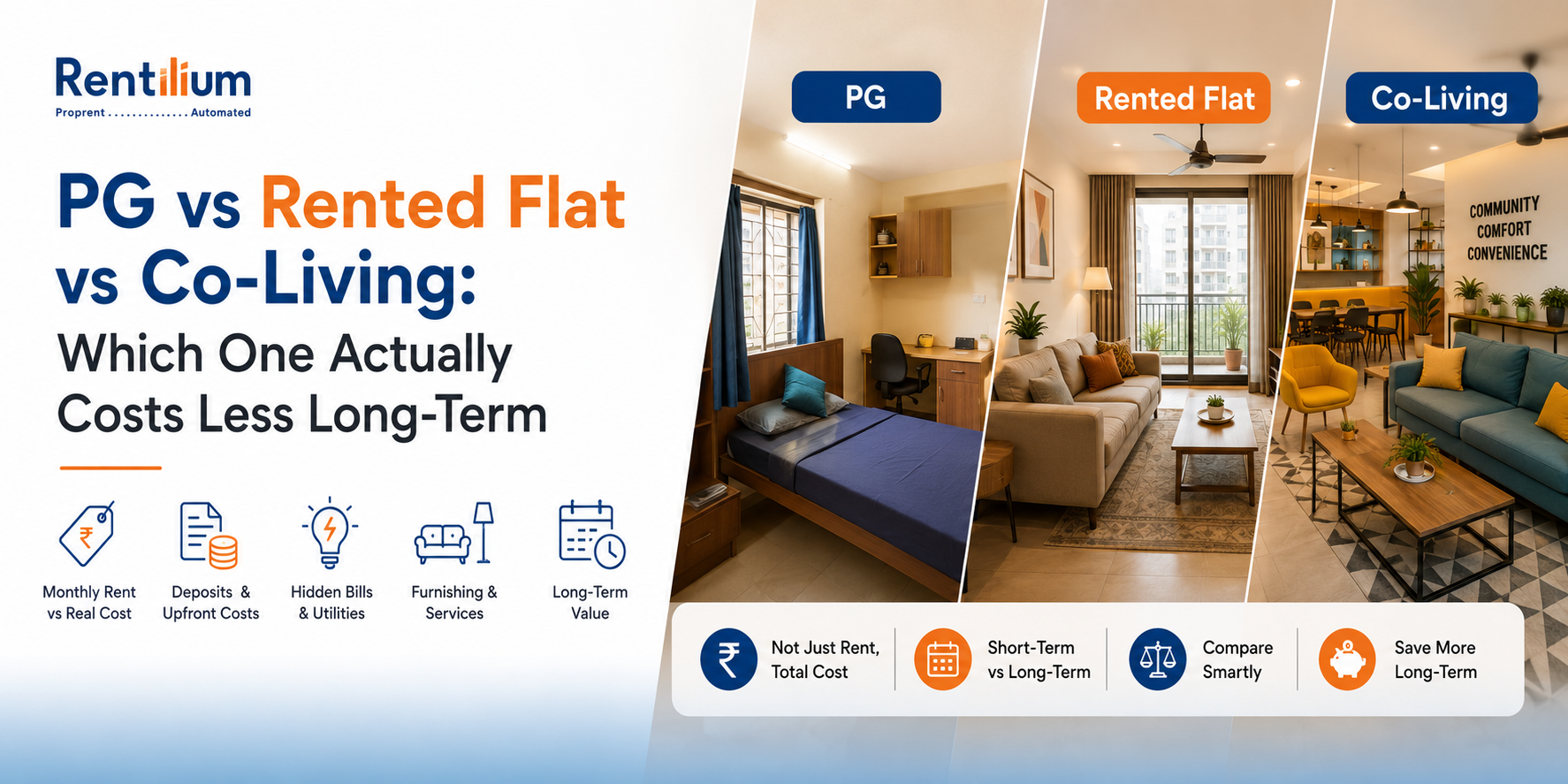
PG vs Rented Flat vs Co-Living: Which One Actually Costs Less Long-Term
Written By- Drashti Bhadesiya
Most rental brochures hide the gap between what you are quoted and what you actually pay.
Someone may move into a PG expecting to pay ₹8,000 every month, only to discover that their actual monthly outgo is much higher once electricity, food, Wi-Fi, laundry, maintenance, and other charges are added.
That is why the real cost of housing is rarely just the number shown on the listing.
Choosing between a PG, rented flat, and co-living space is therefore not simply a comparison of headline rent. It is a long-term financial decision involving recurring expenses, upfront deposits, brokerage, furnishing, utilities, convenience, flexibility, and how long you plan to stay.
In this blog, we compare all three options using the complete cost picture rather than monthly rent alone.
Key Takeaways
PGs may look inexpensive on paper, but electricity and other additional charges can increase the real monthly cost.
Rented flats usually demand more money upfront through deposits, brokerage, furniture, and setup costs.
Co-living may appear more expensive but often bundles services that PG or flat residents pay for separately.
Sharing a flat can significantly reduce the per-person monthly cost when expenses are divided fairly.
The best option often becomes clearer only after comparing the total cost over several months rather than looking at the first month's rent.
The Lie Where It All Begins: Why Monthly Rent Isn't the Real Number
Most housing comparisons stop at monthly rent, and that can be misleading.
A ₹15,000 rented flat and a ₹15,000 co-living room do not necessarily cost the same every month.
The flat's rent may exclude electricity, Wi-Fi, maintenance, house help, furniture, and other expenses. A co-living price may already include several of these services.
To compare housing options fairly, calculate the fully loaded monthly cost — not just the rent shown on the listing.
The Electricity Trap and Other Hidden Bills
One of the hidden-cost shocks highlighted in the source is electricity pricing in PG accommodation.
Some PG properties may charge electricity separately at rates higher than tenants expect. Add laundry, Wi-Fi, maintenance, and other services, and the real monthly outgo can become considerably higher than the advertised rent.
Before choosing a PG, ask exactly how electricity is calculated, whether there is individual sub-metering, and which services are included in the monthly rent.
Questions to Ask Before Booking a PG
- What is the electricity charge per unit?
- Does the room have an individual sub-meter?
- Is Wi-Fi included?
- Is laundry included?
- Are there separate maintenance charges?
- Is food included in the quoted price?
Deposits, Brokerage and Furniture: The Upfront Shock
Long-term cost is not only about monthly expenses. You also need to consider how much cash is required on day one.
According to the source, renting an independent flat may require a deposit of multiple months' rent. Brokerage and furnishing can add another layer of upfront expense.
When renting a flat, you may need to budget for:
- Brokerage
- Security deposit
- Furniture
- Appliances
- Separate utility bills
These costs make the entry barrier of an independent flat significantly higher than many PG or co-living arrangements.
For someone with limited savings or uncertain plans, this upfront difference can have a major influence on the decision.
PG vs Flat vs Co-Living at a Glance
| Factor | PG | Rented Flat | Co-Living |
|---|---|---|---|
| Upfront Cost | Usually lower | Usually highest | Usually lower than a flat |
| Utilities | May be charged separately | Usually separate | Often bundled |
| Furniture | Usually provided | Depends on property | Usually provided |
| Housekeeping | Depends on PG | Usually self-arranged | Commonly included |
| Flexibility | Often suitable for shorter stays | Better suited to longer stays | Often positioned as flexible |
| Privacy & Freedom | Usually lower | Usually highest | Between PG and private flat |
PG
- Upfront: Usually lower
- Utilities: May be separate
- Furniture: Usually included
- Best suited for: Shorter or uncertain stays
Rented Flat
- Upfront: Usually highest
- Utilities: Usually separate
- Furniture: May require setup
- Best suited for: Longer stays
Co-Living
- Upfront: Often lower than a flat
- Utilities: Commonly bundled
- Furniture: Usually included
- Best suited for: Convenience and flexibility
The Six-Month Rule: When Each Option Starts Paying Off
Cost-effectiveness changes depending on how long you stay.
PGs can be convenient for the first few months because the upfront commitment is relatively low.
A private flat, however, may become financially more attractive over a longer stay because its initial deposit, brokerage, and setup costs are spread across more months.
If you expect to relocate within three or four months, a PG or co-living space may help you avoid the larger setup commitment of an independent flat.
If you expect to remain in the same city and neighbourhood for a year or more, a rented flat may offer better long-term economics, especially when shared.
The same housing option does not have to be right at every stage of your life. Your best choice may change once you know how long you plan to stay in the city.
Co-Living's Convenience Tax: Is Bundled Pricing Worth It?
Co-living may have a higher headline price than a traditional PG. The difference is that the quoted amount can include many services that would otherwise be paid separately.
The source describes common co-living amenities such as:
- Professional management
- Furnished rooms
- Housekeeping
- Food
- Community spaces
- Security
Whether the higher headline rent is worthwhile depends on what the alternative PG would actually cost after adding electricity, food, Wi-Fi, laundry, housekeeping, and other top-ups.
The fair comparison is therefore between the complete PG monthly outgo and the complete co-living monthly outgo.
Flatmates, Roommates, and the Math of Sharing a Flat
One option that is easy to underestimate is sharing an independent flat.
When the rent and utilities of a two- or three-bedroom apartment are divided between multiple people, the per-person monthly cost can become competitive with — or even lower than — premium PG and co-living options.
The trade-off is coordination.
You depend on your flatmates to:
- Split bills fairly
- Pay rent and utilities on time
- Take responsibility for damage
- Follow shared-house expectations
- Give reasonable notice before moving out
If one flatmate suddenly leaves, the remaining tenants may have to cover their share until a replacement is found.
The Hidden Cost of Moving Cities Every Few Months
Long-term housing calculations often assume you will stay in one place, but frequent relocation can change the economics completely.
Every move can mean another deposit, possible brokerage, moving expenses, setup costs, and sometimes financial loss related to notice periods or early exits.
This is why flexible, lower-commitment formats may make more sense for people who move frequently, even if their monthly price looks higher.
The cheapest housing option on paper can become the most expensive option if it repeatedly forces you to pay deposits, brokerage, and relocation costs.
Which Option Makes Sense for You?
Consider a PG If
- You are new to the city.
- Your stay may be short.
- You want lower upfront commitment.
- You do not want to furnish a property.
Consider a Flat If
- You expect to stay longer.
- You value privacy and freedom.
- You can manage the higher upfront cost.
- You can share expenses with reliable flatmates.
Consider Co-Living If
- You prefer bundled pricing.
- You value managed services.
- You want furnished accommodation.
- You value community and flexibility.
Conclusion
There is no universal winner in the PG vs rented flat vs co-living debate.
If you are new to a city and unsure how long you will stay, the lower upfront commitment of a PG or co-living arrangement may protect you from locking too much money into deposits and setup costs.
If you already know you will stay for a year or longer, a rented flat can become more attractive over time, particularly if you share it with reliable flatmates.
Whichever option you choose, the real long-term cost becomes visible only after adding electricity, food, deposits, brokerage, furniture, utilities, and relocation costs.
The smartest move is not simply choosing the housing category with the lowest advertised rent. It is doing the complete math before signing.
Frequently Asked Questions (FAQs)
1. Is a PG cheaper than a flat in the long run?
Not always. A PG's monthly cost can increase after electricity, food, service charges, and other expenses are included. The better option depends on the total monthly outgo and how long you plan to stay.
2. When does renting a flat become better than a PG?
The source suggests that the economics of a flat may become more attractive after roughly six months as the upfront deposit, brokerage, and setup costs are spread across a longer period.
3. Why is co-living more expensive than a PG on paper?
Co-living may bundle furnishing, food, Wi-Fi, housekeeping, security, and other services into the monthly price, whereas some PGs charge separately for these services.
4. Is sharing a flat cheaper than a PG or co-living?
It can be. Dividing rent and utilities between reliable flatmates can significantly reduce the per-person cost, although the result depends on the rent, number of occupants, and how fairly expenses are shared.
5. What is the biggest hidden cost people forget to calculate?
The source highlights PG electricity charges as an important hidden expense. Frequent movers should also account for repeated deposits, brokerage, relocation expenses, and possible notice-period losses.