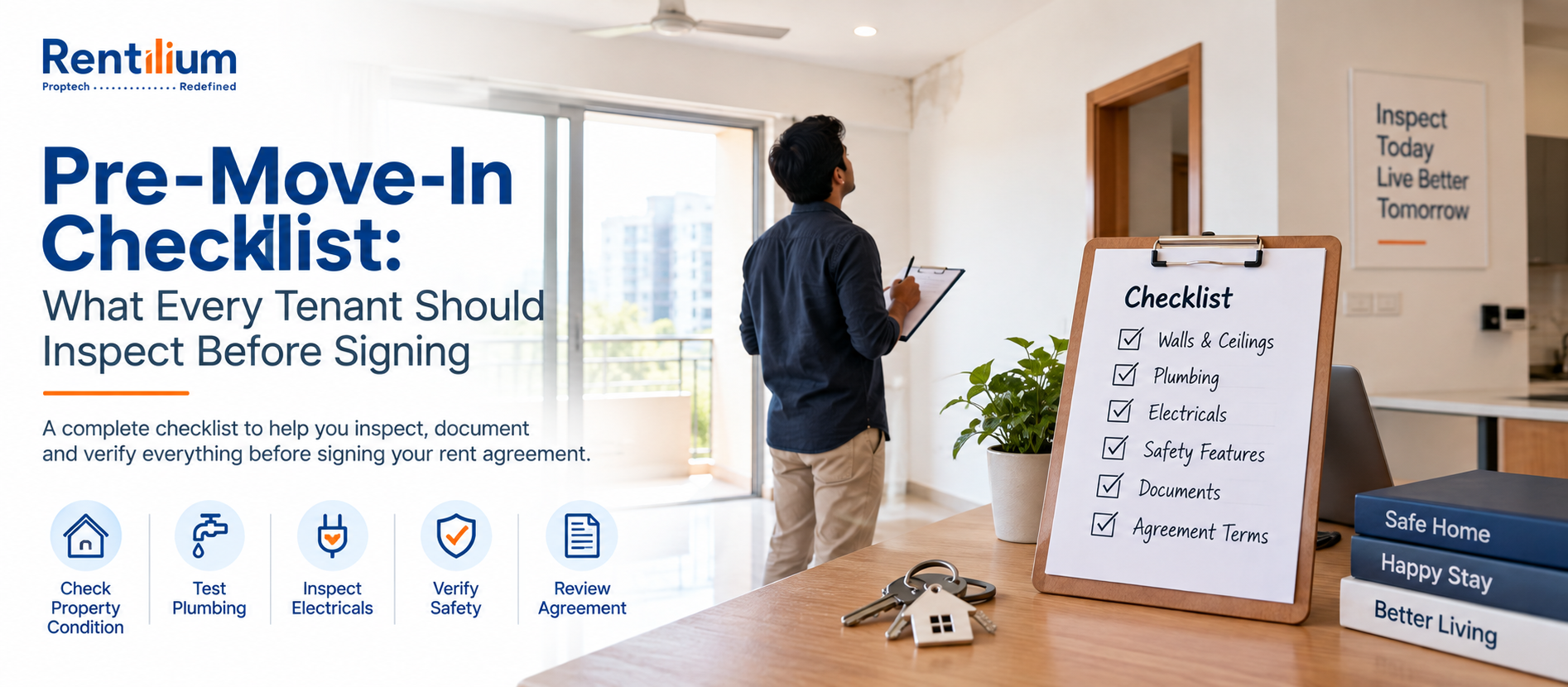
Pre-Move-In Checklist: What Every Tenant Should Inspect Before Signing
Somewhere in India right now, a broker is standing in an empty flat, looking forward to handing the keys to a tenant, and assuring them that the place is perfect. The tenant takes a quick walkthrough and decides to check the geyser later. This delay is where things go wrong.
Across India's biggest rental markets, approximately ₹1.26 trillion is sitting with landlords as security deposits. In Bangalore, deposits have become so common that 75% of tenants have had to move out because they could not afford the advance.
The silver lining here is that this mess is avoidable. A careful inspection before signing costs nothing and saves you from unnecessary stress while moving out. This blog walks you through what deserves your attention before you sign a rent agreement.
Key Takeaways
- Inspecting thoroughly before committing is important.
- Insist on a written and signed condition report from the owner.
- Read the rent agreement completely and carefully.
- Understand your city's registration, stamp duty, and police verification requirements before signing.
Why Inspecting Before Signing Matters
The moment you sign a rent agreement, the property's condition becomes your baseline. Anything that is flagged as damage later, be it a scratch, a stain, or a broken fitting, will be compared with it. Without documentation, you cannot prove that the damage was not your fault.
Security deposits are the most common cause of disputes between landlords and tenants since most tenancies still run on trust and memory rather than any formal record.
In Delhi-NCR, 58% of tenants report getting their deposit back, and only 12% report a dispute at all. A thorough inspection is not about distrust. It is about giving both sides a provable record. Often, it makes room to negotiate a repair or a lower deposit before an agreement binds you.
Checking the Structural and Physical Condition
Start by inspecting the walls, ceilings, and floors. They tell you far more about a place than a broker's pitch.
- Walls and ceilings: Look for seepage marks, peeling paint, or damp patches, especially near the bathroom and kitchen walls.
- Floors: Check for loose tiles, hollow-sounding patches, or uneven flooring in every room.
- Doors and windows: Test every door and window. Rusted hinges or windows that do not seal properly are common in coastal cities and older buildings.
- Bathrooms: Check for seepage below the wash basin, a functioning flush, and whether the exhaust fan works.
- Cracks: Though hairline cracks are usually cosmetic, wide or spreading cracks deserve your attention, especially in older buildings.
Take photos and videos of every room, including close-ups of any flaw you come across. Plus, time-stamped documentation is your best friend here.
Inspecting Plumbing and Electrical Systems
These systems often go unnoticed until they fail. It is better to test the following while you still have time:
- Taps and showers: Run every tap. Check water pressure, and ask whether the supply comes from a municipal corporation, borewell, or tanker.
- Geyser and water heater: Ask its age and whether it has been serviced, as it is one of the first appliances to break down.
- Drainage: Run water in every sink and check how fast it drains. Slow drainage is a sign of poor pipework.
- Switchboards and wiring: Test every socket. Note anything that sparks, feels loose, or does not work.
- Power backup and inverter: Ask if the place has an inverter or generator backup, and which appliances it covers.
- MCB and meter: Locate the electricity meter and MCB box. Ensure that the meter reading is noted at the time of handover.
Safety Essentials You Can't Skip
Some items on this checklist are not about comfort. They are about whether you and your family are protected if something goes wrong.
- Fire safety: Check whether the building has functioning fire extinguishers, marked fire exits, and a working fire alarm system.
- Main door and grill locks: Test every lock, balcony grill, and security gate.
- Gas connection: If a cylinder or piped gas connection is provided, check the regulator, pipe condition, and whether there is a gas leak detector.
- Society security: Ask about security guard timings, CCTV coverage, and visitor entry protocols.
- Emergency exits: Confirm whether the staircase is well-lit and unobstructed.
Note anything faulty in writing before you sign the agreement, and get a clear, written commitment from the landlord on when it will be fixed.
Documentation: Your Deposit's Best Defence
This step matters the most when a dispute arises, and is often skipped by many tenants.
- Record everything, including minor imperfections like a chipped tile or a loose cupboard hinge.
- Insist on a written condition report as an annexure to the rent agreement, signed by both you and the landlord.
- Get receipts for every payment, including the token amount and security deposit.
- Note the electricity and water meter readings at handover, and keep a copy of the last paid utility bills to avoid inheriting old dues.
Lease and Financial Fine Print
The condition of the flat matters, and so does the paperwork. The following clauses must be read carefully:
- Deposit amount and refund terms: While the Model Tenancy Act, 2021 recommends capping residential deposits at two months' rent, it applies only in the states that have formally adopted it. Get the refund timeline in writing.
- Rent agreement duration: Most agreements run for 11 months to avoid mandatory registration and higher stamp duty. Read yours carefully.
- Stamp duty and registration: Though agreements are commonly e-stamped, registration is mandatory in some states regardless of the tenure.
- Maintenance and society charges: Clarify whether maintenance, parking, and other amenity charges are included in the rent or billed separately.
- Lock-in and notice period: Understand how many months you are committed to staying, and how much notice period must be given before ending the tenancy.
- Rent escalation clause: Ask whether and by how much the rent will increase on renewal.
If anything is unclear, ask for it in writing in the rent agreement, not just verbally.
Rules and Practical Considerations
Beyond the walls and the paperwork, a few everyday practicalities can shape your whole tenancy experience:
- Police verification: Most cities require tenant police verification, which is usually the landlord's responsibility. You will have to cooperate with the process.
- Documents to keep ready: Aadhaar, PAN, passport-size photos, and visa are generally required.
- Water supply and power cuts: Ask about the frequency of water tanker dependency or scheduled power cuts in the locality.
- Society/RWA rules: Request a copy of any resident welfare association rules.
- Neighbourhood: Visit the locality at different times of day to get a sense of the surroundings and safety.
- Broker and token amount: Confirm brokerage terms upfront and get a receipt for any token amount paid before signing.
Final Steps Before You Sign
Before you sign, do one last pass:
- Compare the signed condition report against your documentation.
- Confirm whether every promised repair has a written commitment.
- Re-read the rent agreement.
- Ensure that the agreement is being e-stamped or registered.
- Keep copies of everything, both digitally and physically.
Conclusion
A pre-move-in inspection is not about suspecting your landlord. It is about ensuring that what you agree to on paper actually matches what you get. With deposits running into several months' rent, your money is at stake.
Tenants who walk away with a fully refunded deposit are ones who took an extra hour, a few photos, and a signed checklist seriously before signing. This one hour is among the best investments you will make as a tenant.
Frequently Asked Questions
What should I photograph during a move-in inspection?
Record every room from multiple angles and take close-ups of the existing flaws.
Is a written condition report legally required in India?
There is no single national requirement, but attaching a signed condition report to your rent agreement is among the strongest pieces of evidence you can have if a dispute arises.
Who is responsible for tenant police verification?
This obligation falls on the landlord, and tenants must cooperate with the process.
Can I negotiate the security deposit amount before signing?
Yes. While the MTA recommends a two-month cap, it only applies in the states that have adopted it. Elsewhere, deposit amounts are negotiable.
What is the biggest mistake tenants make during inspections?
Relying on verbal assurances instead of documenting everything. Without photos, a signed condition report, and payment receipts, you have no strong ground.