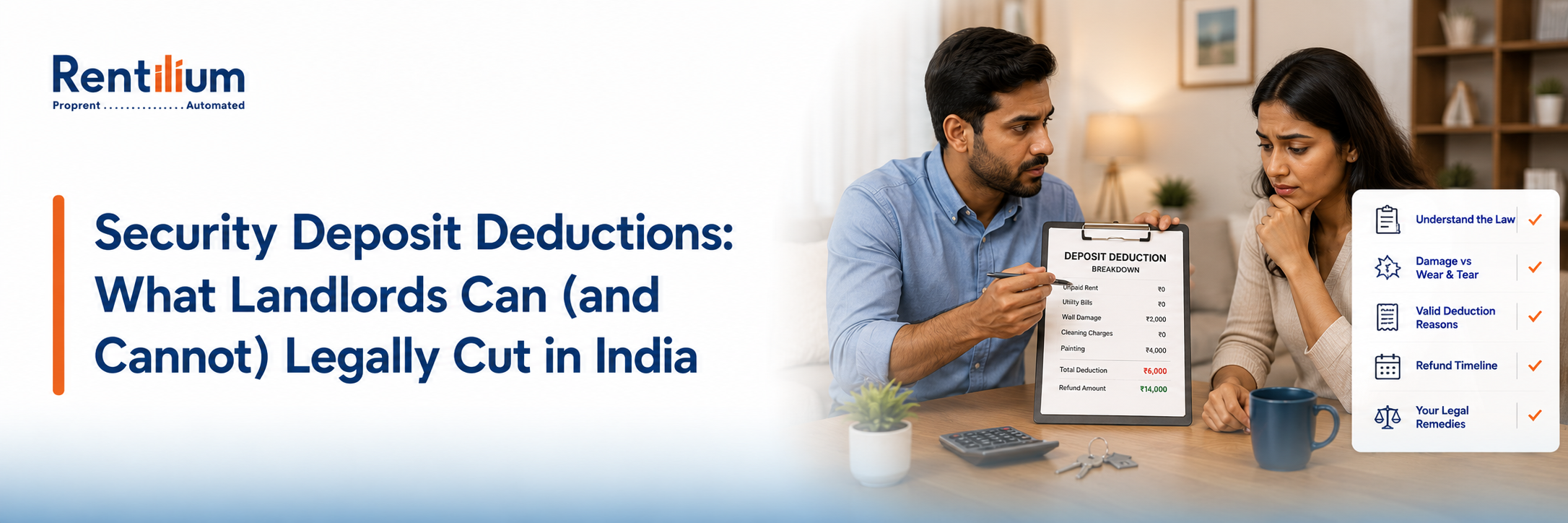
Security Deposit Deductions: What Landlords Can (and Cannot) Legally Cut in India
Written by: Drashti Bhadesiya
Ask any tenant living in a metro city about their last move-out, and you are likely to hear the same story - a landlord holding back part of the security deposit while citing damage that looks more like ordinary wear and tear.
Security deposits of several months' rent are still common across major Indian cities, even though the Model Tenancy Act, 2021 proposes lower limits for residential and commercial properties.
This guide explains what landlords can deduct, what they should not deduct, how normal wear and tear differs from actual damage, and what tenants can do when a deposit dispute remains unresolved.
Key Takeaways
- The Model Tenancy Act, 2021 proposes a cap of two months' rent for residential deposits and six months' rent for commercial deposits.
- Landlords can generally deduct unpaid rent, unpaid bills, and genuine damage beyond normal wear and tear.
- Whitewashing and structural work are generally treated as landlord responsibilities under the framework described in the article.
- Refund timelines may range from around 7 to 30 days depending on the state and rental agreement.
- Tenants facing unfair deductions can escalate through written notices and the appropriate Rent Authority, court, or forum.
The Deposit Rule: Why Tenants Hand Over 2–10 Months' Rent
India's security deposit culture can involve significantly larger amounts than the caps proposed under the Model Tenancy Act.
The Model Tenancy Act recommends a maximum deposit of two months' rent for residential properties and six months' rent for commercial properties.
However, because land and rent control fall under the State List, the Model Tenancy Act only becomes legally effective when adopted by the respective state.
The Legal Green List: What Landlords Can Actually Deduct
According to the article, lawful security deposit deductions generally fall into three broad categories.
1. Unpaid Rent and Bills
Outstanding rent, utility bills, or society maintenance dues may be adjusted from the security deposit at move-out.
2. Genuine Property Damage
Repair costs for damage beyond normal use may be deductible, including broken fittings, significant wall damage, cracked tiles, missing fixtures, or damaged furniture.
3. Agreed Tenant Charges
Charges that the rental agreement clearly assigns to the tenant may also be deductible when they were agreed to in writing beforehand.
The Wear-and-Tear Line: Peeling Paint vs Punched-In Walls
The biggest source of security deposit disputes is often the difference between ordinary wear and tear and actual damage.
Normal Wear & Tear
- Peeling paint from age
- Faded walls
- Worn cabinet hinges
- Normal ageing of fittings
- Minor marks from ordinary use
Actual Damage
- Drilled holes in walls
- Broken window glass
- Cracked tiles
- Missing fixtures
- Damaged furniture
The Red List: Deductions That May Not Hold Up
Certain deductions are more likely to be challenged when they are vague, undocumented, or relate only to ordinary ageing.
- Full repainting after a long tenancy where the walls only show light fading
- Charges for peeling paint or naturally worn hinges
- Vague damage claims without an itemized breakdown
- Charges unsupported by invoices, photographs, or other proof
Who Fixes What: The Landlord–Tenant Repair Split
A large part of deposit confusion comes from unclear repair responsibilities during the tenancy.
| Landlord Responsibility | Tenant Responsibility |
|---|---|
| Whitewashing walls | Daily cleanliness |
| Painting doors and windows | Minor switch and socket repairs |
| Structural repairs | Kitchen fixture upkeep and replacement of broken glass |
The Refund Clock: How Long Landlords Have to Return the Deposit
Refund timelines in India vary depending on the state and the rental agreement.
The article notes that practical refund windows often fall between approximately 7 and 30 days after move-out.
Landlords should also provide a written breakdown of deductions rather than simply returning a reduced amount without explanation.
When Landlords Refuse: Legal Notice, Rent Court, and Small Causes Court
When a landlord withholds the deposit on terms the tenant believes are unfair, the dispute can be escalated through formal channels.
Step 1: Written Demand or Legal Notice
The first step is usually to ask for the refund and deduction breakdown formally in writing.
Step 2: Rent Authority
In states that have adopted the relevant Model Tenancy Act framework, disputes may be taken before the appropriate Rent Authority.
Step 3: Court or Consumer Forum
Depending on the jurisdiction, tenants may also approach the appropriate Small Causes Court, civil forum, or consumer forum.
Documentation That Helps Prevent Deposit Disputes
- A signed rental agreement that clearly defines repair responsibilities
- Move-in condition photographs and videos
- Move-out condition photographs and videos
- Rent and utility payment receipts
- Itemized deduction list
- Repair bills and invoices supporting deductions
- Written communication between landlord and tenant
Conclusion
The gap between what landlords may legally deduct and what actually gets deducted often comes down to unclear boundaries around normal wear and tear and actual damage.
A written rental agreement, documented move-in and move-out condition checks, and an itemized, receipt-backed deduction list can resolve many disputes before they reach a Rent Authority or court.
Until rental laws become more uniform across states, clear documentation remains one of the strongest protections available to both landlords and tenants.
Frequently Asked Questions (FAQs)
1. Can a landlord deduct for peeling paint or faded walls after a long tenancy?
According to the article, ordinary fading and peeling caused by normal use are generally treated as normal wear and tear rather than tenant damage.
2. How much security deposit can a landlord legally ask for in India?
The Model Tenancy Act proposes caps of two months' rent for residential properties and six months' rent for commercial properties, but this depends on whether the relevant state has adopted the framework.
3. How long does a landlord have to refund the security deposit after move-out?
The article states that practical refund timelines generally range from about 7 to 30 days depending on the state and the rental agreement.
4. Is the security deposit taxable or subject to TDS?
The article states that a refundable security deposit is generally not treated as rent unless it is subsequently adjusted against rent.
5. What can a tenant do if a landlord refuses to refund the security deposit fairly?
The article suggests starting with a formal legal notice and, if needed, approaching the appropriate Rent Authority, Small Causes Court, or consumer forum depending on the jurisdiction.