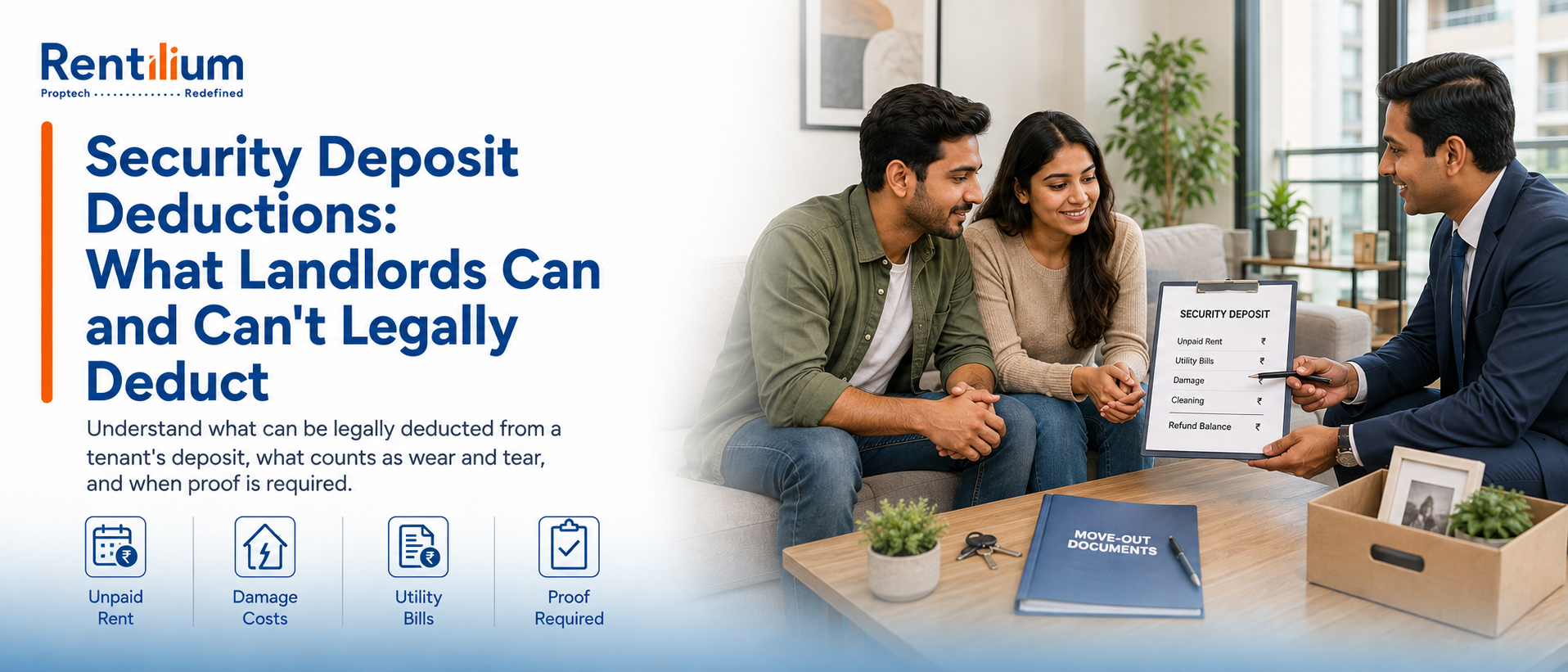
Security Deposit Deductions: What Landlords Can and Can't Legally Deduct
Written By- Drashti Bhadesiya
Are you constantly on the constant watch-out of receiving your security deposit after moving out of your rented place?
Well, you are not alone.
The most common trigger that leads to serious landlord-tenant disputes at move-out is security deposits. They happen because neither the landlord nor the tenant documents the property’s condition well enough to prove that the damage caused is not their fault.
Section 108(m) of the Transfer of Property Act, 1882 explains the difference between normal wear and tear, the cost of which a landlord bears and damage caused by a tenant, which can be deducted from the security deposit.
This article is all about explaining what a landlord can deduct from security deposits, deductions, and landlord-tenant disagreements.
Key Takeaways
The Model Tenancy Act, 2021 allows two months’ rent as a security deposit. However, it has not been adopted by every state.
Deductions like unpaid rent, damage, cleaning charges, and breach costs are deductible only with receipts, invoices, or other evidence.
Wear and tear is the landlord’s cost to absorb, and any deduction without an itemised breakdown is invalid.
Security deposits are generally returned 15-30 days after vacancy of the property.
How Much Can a Landlord Legally Collect as Deposit?
The Model Tenancy Act, 2021 (MTA) claims that landlords cannot ask for more than two months' rent as a security deposit for residential properties and six months' rent for commercial properties. However, this is not the market reality in most of India. The MTA is a template law, not a binding statute. States have to adopt it individually.
Assam was the first state to fully adopt the MTA. The rest are Uttar Pradesh, Andhra Pradesh, and Tamil Nadu.
Karnataka and Maharashtra have adopted it partially. In 2017 and 2018, Tamil Nadu and Andhra Pradesh passed their own versions of the act. Since states not following the MTA have no legal cap, landlords often ask for 6-10 months' rent as a security deposit.
What Can Landlords Legally Deduct From a Security Deposit?
This section lists five things a landlord can deduct from the deposit. However, each of them requires proof:
1. Unpaid rent for the final month
A landlord can deduct the rent from the deposit if it is not paid before the tenant leaves the property.
2. Remaining utility, electricity, water, or society maintenance bills
If there are invoices or receipts, a landlord can deduct these charges.
3. Repair costs for damage caused by the tenant
This deduction is triggered by the tenant’s fault, not because something aged with time. Such damage includes a cracked tile or broken furniture.
4. Cleaning or repainting charges
If mentioned in the rental agreement, a landlord can deduct these charges. If there is no such clause in the signed contract, then they cannot be deducted from the deposit.
5. Costs tied to a contractual breach
Terminating the lease before the agreed term without proper notice can lead to a deduction.
Every deduction must have proof. This standard is used by most Indian rent agreements to evaluate deposit disputes, even if the state has not adopted the MTA formally.
What Can't Landlords Legally Deduct From a Security Deposit?
The following four categories get disputed constantly, and landlords lose most of them once documentation is required:
| Not Deductible | Reason |
|---|---|
| Normal wear and tear like faded paint, minor scuffs, worn flooring | According to Section 108(m) of the Transfer of Property Act, 1882, deterioration from everyday use is treated as the landlord's cost of doing business, not tenant liability |
| Undocumented damage | Without documents, no claim can be enforced on a tenant |
| Deposit interest | Since most Indian rental agreements do not include an interest clause, there is no ground to pay interest or withhold funds |
| Arbitrary lump-sum withholding | A deduction with no itemised breakdown is not permitted |
Majorly, landlord-tenant disputes happen because of wear and tear. This damage raises one question: was it the tenant’s fault?
How Long Does a Landlord Have to Return a Security Deposit?
In most Indian rental markets, the standard practice is to return the deposit 15 to 30 days after the tenant leaves the property. It is the landlord’s responsibility to settle the final bills, inspect the property properly, and calculate what the tenant owes in these 15-30 days.
However, this window works only if the landlord provides a written, itemised breakdown of any deductions alongside the remaining balance. A refund without any explanation is invalid despite arriving on time.
What Can a Tenant Do If a Landlord Won't Refund or Over-Deducts?
In such cases, tenants have a formal escalation path, which depends on whether their state has adopted the MTA. In states where the MTA has been adopted, a tenant can file a complaint with the Rent Authority directly. In states that do not follow the MTA, the route runs through the state's existing rent control tribunal and even civil court.
Before matters escalate, the single most effective protection a tenant has is photo and video documentation of the property's condition at move-in, which should be timestamped and record every corner. This record is what turns a dispute from "my word against yours" into a straightforward before-and-after comparison, and is usually enough to resolve a disagreement before it gets too late.
How to Avoid Security Deposit Disputes Before They Start
Most disputes can be prevented if the following three steps are taken:
1. Photographs and video of the property at move-in and move-out
Room by room, with close-ups of existing wear, this is the evidence that ends arguments before they even start.
2. Write the terms into the agreement itself
Specify what counts as damage, what cleaning charges apply, and how deductions get calculated before signing the agreement. Never rely on verbal promises.
3. Use a digital lease format with timestamped records
Most deposit disputes trace back to a verbal term which neither party can vouch for. Using timestamped agreements removes the ambiguity a verbal understanding leaves behind.
While none of these measures guarantee a completely dispute-free move-out, they do shift every disagreement from vague claims to documented reality.
Conclusion
The distinction that decides every deposit dispute is documentation. A deduction is legally defensible when it is itemised, backed by receipts or photos, and tied to actual damage or dues. Everything else, no matter how reasonable it sounds verbally, is a negotiating position, not a legal right.
The tenants and landlords who avoid disputes entirely are the ones who put the property's condition and the deposit terms in writing before anyone finds a reason to argue about them.
FAQs
1. Can a landlord deduct from the security deposit for damage caused by wear and tear?
No. Faded paint, minor scuffs, worn flooring, etc caused by ordinary, daily use are treated as wear and tear, which is the landlord's cost to absorb, not the tenant's. Deductions only apply to damage that goes beyond what is expected from everyday living.
2. In how much time does a landlord usually return the security deposit?
A landlord usually returns the deposit in 15 to 30 days after the tenant moves out, but is not a fixed deadline. In this span, they verify the final dues, inspect the property properly, and share an itemised breakdown with the tenant.
3. Is deposit interest a legal requirement in India?
No, unless the rental agreement specifically includes an interest clause, which most rental agreements do not mention. This means that landlords usually are not obligated to pay interest on a deposit. On the same grounds, they have no legal right to withhold money by citing interest owed either.
4. What proof should a landlord have to justify a deduction?
A landlord must have supporting invoices, receipts, or dated photo and video evidence regarding the damage or due amount. A deduction without this kind of documentation is considered arbitrary and generally does not hold up if the tenant disputes it formally.
5. Can a tenant receive an over-deducted deposit back?
Yes. In states that have adopted the MTA, a tenant can file with the Rent Authority directly if their deposit has been over-deducted. In other states, the state's rent control tribunal or civil court takes charge. Either way, move-in documentation helps in strengthening the claim significantly.