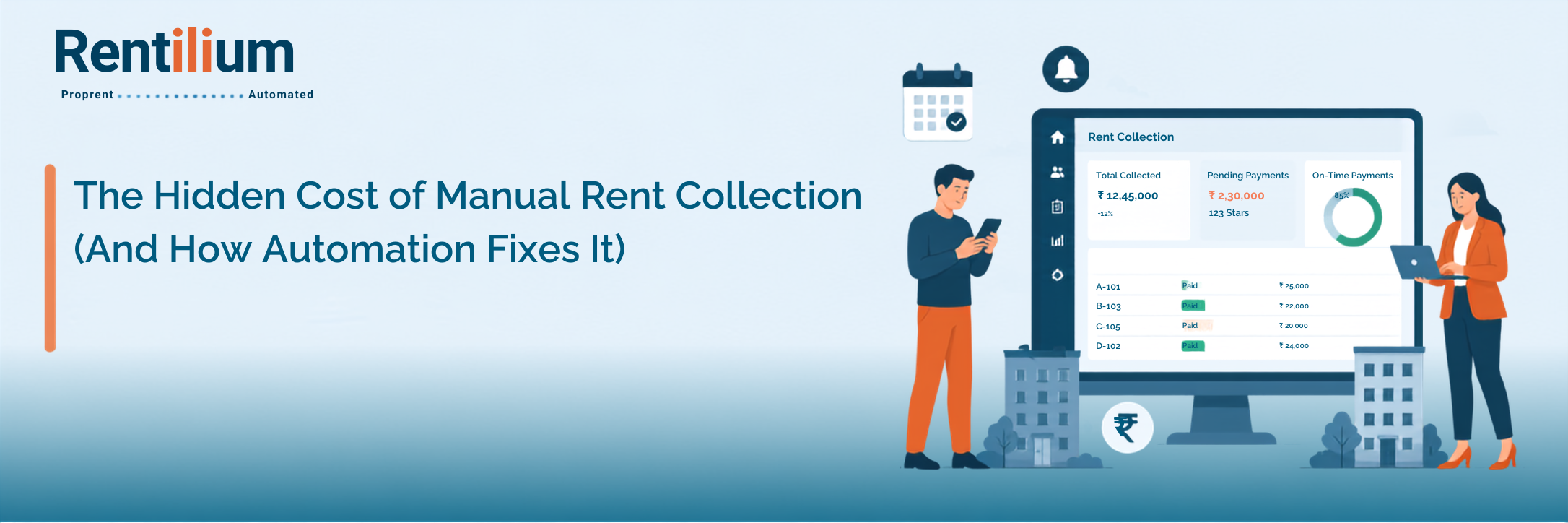
The Hidden Cost of Manual Rent Collection (And How Automation Fixes It)
It’s 11 p.m., and you’re still scrolling WhatsApp for a tenant’s payment screenshot, cross-checking it against a bank statement, and then updating a spreadsheet by hand. This is not rent collection - it is simply a second job. Most owners treat rent collection as a simple task - tenant pays, and the manager records it.
However, in reality, it’s a full financial and operational workflow involving multiple follow-ups, reminders, reconciliation, reporting, and trust between owners, managers, and tenants. As per some studies, it is known that automated reminders alone help push over 80% of tenants to pay on time.
Why Manual Rent Collection Still Exists?
Manual rent collection has become so outdated, yet why is it still there? Let’s find out below:
1. Legacy Habits Die Hard
Many landlords and property managers still rely upon cash, checks, and bank transfers tracked across Excel sheets, WhatsApp chats, and paper ledgers. Such tools feel familiar, and this is the reason why switching feels like an unnecessary hassle.
2. “Our Portfolio Is Too Small to Need Software”
A common assumption that many small landlords and even new property managers usually make is that the adoption is only for large-scale firms that have hundreds of units. Due to this mindset, the adoption gets delayed until the manual system is already breaking down under pressure. In reality, the earlier you adopt automated rent collection, the easier it will be later.
3. The Reality - Pain Compounds with Scale
One late-paying tenant is truly annoying - fifty late-paying tenants across multiple owners is a crisis.
As the portfolio grows, so does the number of stakeholders involved - property owners wanting visibility, managers juggling reminders, and tenants expecting a smooth payment experience.
This is the multi-stakeholder complexity that a unified property management ERP such as Rentilium is built to solve.
The Hidden Cost of Manual Rent Collection
The Time Cost
Chasing the tenants to get proof of transfer, reconciling payments, and updating the spreadsheets can quietly eat up at least 10-15 hours a month per manager. That time could be used in leasing new units, handling maintenance requests, and growing the portfolio. Every hour lost to manual rent collection is an hour that’s stolen from actual business growth.
The Cash Flow Cost
When the rent comes in late, owner payouts get delayed - and this damages trust between the manager and the property owner. One late tenant is still manageable, but across a portfolio of 50 units, even a handful of stragglers can create a real cash flow bottleneck. According to research, automated rent collection systems can cut late payments by up to 50%.
The Error & Reconciliation Cost
Manual level of data entry invites mistakes - missed payments, double charges, and even the ledgers don’t really match the bank records sometimes. Fixing these errors eats up even more hours than entering the data correctly the first time, and in certain worse cases, it opens up the doors to legal exposure. What starts as merely a typo can turn into a dispute which might take even weeks to untangle.
The Communication & Trust Cost
Owners who’re unable to witness real-time rent collection status tend to lose confidence in their property managers, even when they’re not making any mistakes. Tenants face the same issue - without having a clear, documented payment trail, even some simple misunderstandings can turn into disputes and strained relationships.
The Compliance & Audit Risk
When proper documentation is missing, late fees usually get applied inconsistently, and audits become a scramble to piece together. This inconsistency isn’t just inefficient - it is a real legal and financial risk. A missing paper trail today can become a costly problem tomorrow.
Quantifying the ROI Drain
1. A Simple Cost Per Unit Framework
Here’s a very simple way to check the drain - take the hours spent per unit on any manual rent task (reconciliation, chasing payments, and reminders), and then multiply by your hourly cost, and then add the value of the late or missed rent.
For a 50-unit portfolio spending even 3 hours per unit per month on manual admin - that is 150 hours, which is nearly a full-time employee’s monthly workload.
2. What Automation Actually Saves
Automated reminders alone are capable of prompting over 80% of the tenants to pay on time and reducing late payments by nearly 50% as compared to manual follow-ups.
How Automation Fixes Each Hidden Cost
The table below mirrors every pain point with the automation that solves it -
| Hidden Cost | How Automation Fixes It |
|---|---|
| Time Loss | Automated reminders, self-service portals, and real-time dashboards reduce manual follow-ups and data entry. |
| Cash Flow Bottlenecks | Faster payments through automated systems improve cash flow and owner payouts. |
| Reconciliation Errors | Automated matching of payments to ledgers reduces errors and saves time on reconciliation. |
| Communication & Trust Issues | Real-time dashboards for owners and tenants improve transparency and trust. |
| Compliance & Audit Risks | Automated documentation and reporting ensure compliance and simplify audits. |
Why “Software” Isn’t Enough - You Need an ERP
There are a lot of tools in the market that just solve one piece of this puzzle - collect payments, send reminders, or just guarantee reports. However, rent collection is not a process to be followed in isolation. It mainly touches accounting, owner communication, tenant relationships, and even compliance - all at once.
That is the reason why software alone isn’t the real fix; it is the property management ERP - a unified system where every stakeholder works from the same live data rather than five distinct tools.
Where Rentilium Fits?
This is exactly the gap that Rentilium was built to close. Being the world’s first ERP for property management, Rentilium brings property owners, organizations, property managers, and tenants all together under one roof.
This makes rent collection seamless and not a standalone chore. Moreover, by using Rentilium, you won’t have to run behind the tenants on WhatsApp or spreadsheets for payments, as everyone sees the same picture automatically.
Why Does an Intelligent ERP (Not Just Payment Software) Matters?
1. A Payment Tool Isn’t the Same as an ERP
Well, many rent collection software only solves just one narrow issue - getting the payment from the tenant to the landlord. However, the payment doesn’t exist in a vacuum. It actually needs a flow into accounting, triggering the owner reports, and also staying documented for compliance.
An ideal property management ERP connects the rent collection to every part of the operation, so that one payment automatically updates the ledger, the owner dashboard, and even the tenant’s payment history at the same time.
2. Rentilium’s Approach - One Platform, Every Stakeholder
Rentilium was built with a simple idea in mind - that property management is not just about the manager or the tenant; it is basically an ecosystem of organizations, managers, owners, and even the tenants who require visibility in the same data.
Rather than forcing each stakeholder onto separate tools, Rentilium brings everyone under just one single platform, so the “hidden costs” simply don’t have any room to form.
What to Look for When Evaluating Automation (Practical Buyer’s Checklist)
If you are actively comparing options, here’s a practical checklist to guide your decision:
1. Automated Recurring Payments & Reminders
It’s ideal to look for a system that automatically schedules rent payments and sends reminders before the due date, and not after it. It’s a fact that approx. 80% of the tenants pay on time when they get automated nudges. So, basically, this feature is itself helpful in transforming your collection rate.
2. Real-Time Dashboards for Owners & Managers
An ideal system helps the owners and the managers with live visibility into who has paid and who hasn’t yet. It also strikes where the cash flow currently stands, while there won’t be any need to ask anyone. This is a feature that eliminates most of the communication hassles that come with manual tracking.
3. Tenant Self Service Payment Portal
Tenants should be able to access the self-service portal that helps them log in, view the payment history, and also enables them to pay in just a few clicks. No chasing, no confusion, and absolutely no spreadsheets. When a self-service portal is implemented, it turns rent payment hassle from a monthly hassle into a ten-minute task.
4. Multi-Stakeholder Access on One Platform
As the task of property management involves owners, organizations, managers, and tenants, it’s essential that your system should give each of them the right level of access on a single platform, and avoid giving it five distinct apps.
Before Rentilium Vs. After Rentilium
Before Rentilium - Manual Chaos
Just imagine a property manager overseeing 60 units across three owners. Every month begins with the same old story - sending reminders on WhatsApp one tenant at a time, checking the bank statements against a spreadsheet, and fielding calls from owners asking, “Has everyone paid yet or not?”
By the time all payments are reconciled and owner payouts are sent, it is just middle of the next month, and even a minor typo in the ledger means another two hours spent tracking down a mismatch.
After Rentilium - Automated Clarity
Now just imagine the same portfolio running on Rentilium. Reminders usually roll out automatically before the rent is due. Tenants are easily able to pay via a self-service portal that hardly takes five minutes. Payments seamlessly match to the ledger the moment they land, and even the owners open their dashboard to see the real-time rent collection status - no phone calls are required at all.
What earlier took a full week of manual workload now runs quietly in the background, freeing up the manager to focus upon leasing and tenant relationships.
The Shift in One Line
It is a difference between managing rent collection and simply watching it happen correctly, every month, on its own.
Conclusion
The actual cost of manual rent collection was not just the late rent - it is basically the hours that get lost while chasing payments, the trust that fades when owners usually lack visibility, and the growing takes a stroll while your team drowns in maintaining spreadsheets.
That is why automated rent collection is actually not just a convenience, but a strategic ROI decision. Rentilium’s super intelligent property management ERP unifies rent collection and communication for organizations, owners, managers, and tenants - all under one platform.
Book a demo with Rentilium today and take your rental experience to the next level.