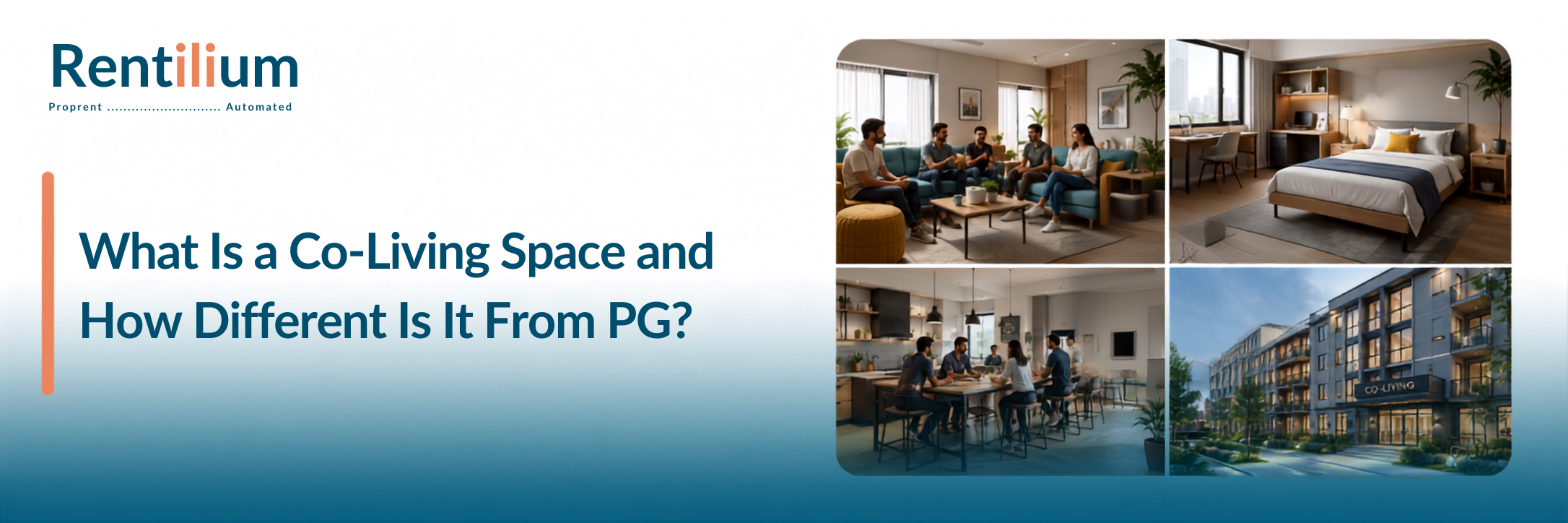
What Is a Co-Living Space and How Different Is It From PG
Relocating for a new job was tough earlier, just by thinking of managing the accommodation, flat-hunting, furnishing, trapped brokers, and endless management regarding the overall search.
Co-living was built to remove that difference and friction, where furnished rooms, utilities, and shorter commitments were driven by better living concepts, and also an easier method to move between cities.
This article is all about knowing more about co-living and understanding the concept with the right facts!
Key Takeaways
- Co-living differs from a PG or flatshare in that it is professionally managed. Furnishing, utilities, housekeeping, and maintenance are typically bundled into one rent instead of being arranged separately.
- Upfront costs are lower than a traditional rental because there is no furnishing spend or brokerage fee, although the monthly rent usually carries a premium over an unfurnished flat.
- Lock-in periods in co-living are generally shorter and more flexible than standard rentals, but this varies by operator and must be confirmed rather than assumed.
- Work-from-home readiness, internet reliability, common workspaces, and noise levels should be checked specifically if you plan to work from the property.
- Spaces managed by a verified operator carry significantly lower fraud risk than those listed by individual landlords or unregistered brokers.
- Community common areas and private room or bathroom availability vary widely between properties and should be checked during a visit rather than assumed from photos.
What Is Co-Living, and How Is It Different From a PG or Flat Share?
A managed, furnished, and shared accommodation handled by a single operator is known as co-living. It is the whole property given for shared living, and not a property owner who sublets a room for rent.
This is considered to be the core difference between co-living and PG. Moreover, a flat share is purely an informal arrangement between tenants, and nobody is involved in between.
Co-living bundles services such as housekeeping, maintenance, WiFi, and community events under one operator and one agreement. This removes the coordination that a PG or flatshare leaves entirely on the tenant.
Co-Living Market Size Evaluation
The global co-living market was valued at $7.8 billion in 2024, expected to reach $9.4 billion in 2026 and $16.1 billion by 2030, growing at a 13.5% CAGR from 2025 to 2030. Asia Pacific leads with a 48.0% revenue share, and the U.S. holds a significant share within that. By segment, single occupancy leads at 48.23%, economy-tier spaces at 53.36%, and students are the largest end-use group at 29.92%.
Source: Co-Living Market Size Value: 2025-2030
Rising urban living costs drive growth. Co-living offers a cheaper, shared alternative to traditional renting by splitting rent, utilities, and maintenance. It appeals most to young professionals, students, and digital nomads who want shorter, flexible leases without long-term commitments or high deposits.
Fully furnished rooms, bundled amenities, and communal spaces such as coworking areas and lounges add convenience and networking value, particularly for millennials and Gen Z. Shared resources and energy-efficient setups also add appeal for environmentally conscious residents.
Who Should Consider Co-Living?
Co-living is suitable for professionals or anyone moving from another state who needs accommodation and does not want a raw flat-living arrangement that must be set up from scratch.
It also works well for remote-first hires who need a proper, ready-to-use workspace without arranging everything themselves. If you are settling into a city for the long term and plan to build a permanent setup, a traditional rental is usually more cost-effective.
How Does Co-Living Rent Work?
Most co-living properties provide basic furniture such as a bed, wardrobe, and desk, along with utilities, WiFi, housekeeping, and other services. Maintenance requests are routed and managed through the operator, which removes the need to coordinate directly with a landlord.
The billing usually includes a fixed monthly rent, while excess electricity may be charged separately. Some operators include meals and some do not.
Before signing any agreement, make sure all inclusions, limits, and additional charges are clearly documented.
Cost Comparison: Co-Living vs Traditional Rental
| Cost Factor | Co-Living | Traditional Rental |
|---|---|---|
| Security deposit | Usually lower, often equal to 1 month's rent | 1-2 months' rent in most cities |
| Furnishing cost | None, because the room comes fully furnished | Rs. 50,000-Rs. 1,50,000+ upfront if the flat is unfurnished |
| Brokerage fee | Usually none when dealing directly with the operator | Often 1 month's rent paid to a broker |
| Monthly rent | Higher because the premium covers services and furnishing | Lower for an equivalent unfurnished flat |
| Utilities and WiFi | Bundled into rent up to a defined cap | Billed separately on top of rent |
| Housekeeping and maintenance | Included | Arranged and paid for separately by the tenant |
| Total upfront cost | Low | High because of deposit, furnishing, and brokerage |
| Best value for | Stays under 12 months | Stays over 12 months |
Check the Lock-In and Notice Period
Co-living operators generally offer shorter lock-ins than standard rentals, often month-to-month or with a 3-month minimum instead of an 11-month lease. This flexibility is one of the main draws for professionals with uncertain tenure.
However, this is not universal. Some operators still enforce longer lock-ins with exit penalties. Confirm the exact lock-in period, notice period, and any early-exit charges in writing before signing rather than assuming that co-living automatically means flexible terms.
Work-From-Home Readiness
If you work remotely even part of the week, test the WiFi speed and reliability during peak hours before committing, not only at the time of your visit.
Check whether the property has a dedicated common workspace or whether you will be working from your room. Also account for noise. Shared common areas near bedrooms can be a problem during work calls, so ask specifically about room placement relative to shared spaces.
Verify Operator Credibility
Because co-living is managed by an operator rather than only by a landlord, it is important to verify the operator's credibility. Check whether co-living is their part-time business or whether they manage multiple properties.
Confirm whether the business is legally registered, how long the operator has been in the industry, and whether there are genuine online reviews or a reliable digital presence.
This step directly reduces the fraud risk associated with unverified brokers or informal sublets.
How RentalGini Helps
Finding a co-living space that genuinely delivers on its promise of a verified operator, bundled services, and flexible terms is harder than it sounds when all listings use similar language. RentalGini simplifies this process directly:
- Verified property listings: Co-living and managed accommodation listings are checked and structured, so you do not have to verify an operator's credibility entirely from scratch.
- Managed living options: RentalGini's managed living services support day-to-day operations for PG and co-living stays, so assistance is not dependent on a single landlord or an informal broker.
- Tenant engagement support: Guided help is available through discovery, booking, and move-in so lock-in terms and inclusions are clear before you sign rather than after.
- Maintenance support: Repair and facility requests move through a coordinated workflow instead of getting lost between the operator and property owner.
Conclusion
Co-living works well for working professionals when the operator is credible and the inclusions are clear. It can fall short quickly when either of those points is not checked upfront.
The flexibility and bundled convenience are real advantages, but they only hold up when you verify the lock-in terms, the room-to-shared-space ratio, and the operator's track record before signing.
Looking for a verified co-living space that is actually built for professionals?
Explore managed co-living options on RentalGini and move in without the guesswork.
FAQs
What is the difference between co-living and a PG?
Co-living is professionally managed by an operator with bundled services such as housekeeping and maintenance, while a PG is typically owner-managed with more basic, informally arranged services.
Is co-living more expensive than renting a flat?
Co-living has lower upfront costs because furnishing and brokerage are not required, but the monthly rent usually carries a premium. For stays under a year, co-living is often cheaper overall; for longer stays, a traditional rental tends to cost less.
Do co-living spaces have a lock-in period?
Most co-living operators offer shorter lock-ins than standard rentals, often month-to-month or with a 3-month minimum. This varies by operator and should be confirmed in writing before signing.
Is co-living suitable for working professionals relocating for a new job?
Yes. Co-living is designed for this situation, offering furnished, move-in-ready rooms without the setup time or cost of a traditional unfurnished rental.
What amenities are typically included in co-living rent?
Furnishing, WiFi, housekeeping, and utilities up to a cap are usually included. Food, laundry, and excess utility usage are often billed separately depending on the operator.