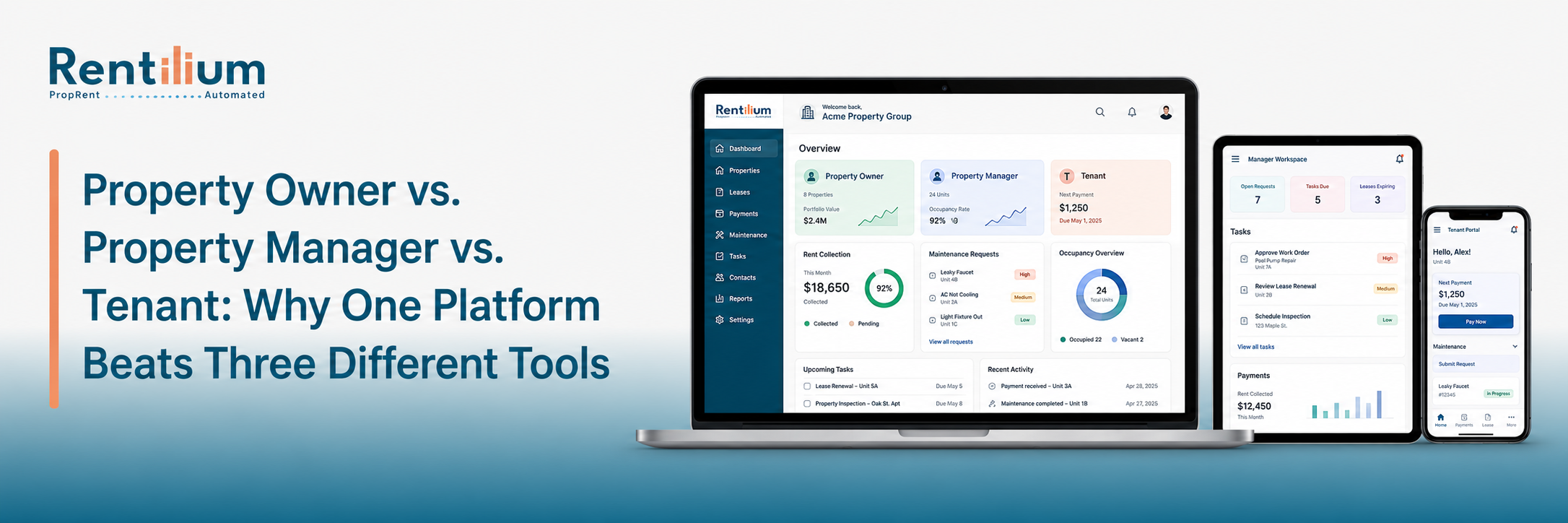
Property Owner vs. Property Manager vs. Tenant: Why One Platform Beats Three Different Tools
Every property owner, manager, and even the tenant knows this scene. The property owner usually checks the spreadsheet to know and verify whether the rent came in or not. However, the property manager is switching between three or four apps in order to track payments, maintenance, and leases. Tenants, on the other hand, just give up and send a text message rather than filing a proper request.
In fact, 39% of the property managers spends approximately 20 hours a month just in handling the maintenance requests - further highlighting the fact that how much time gets killed for maintaining all these tasks.
A lot of property management software tools are built for just one user, usually the manager. Owners and the tenants get added later. However, each side requires different things, and when the tools don’t talk to each other, smaller gaps turn into missed payments, slow repairs, and broken trust. Rentilium was built with a different thought in mind - with owners, managers, and tenants on one connected platform from day one.
Why Fragmented Tools Fail Property Management Teams?
Just walk into any property management operation today, and you will witness a patchwork of tools duct-taped together.
Owners of the properties usually rely upon accounting software in order to keep a track record of their income and expenses.
However, managers usually maintain a separate tool to handle repairs and vendors.
Tenants, on the contrary, pay rent via one app, then use a separate tool to text/email the manager. None of these systems were designed to talk to each other - and that is where the real cost shows up.
Data silos are the first and foremost casualty. In simple words, the property owner has no idea what a tenant complained about three days ago, because that information resides inside the manager’s maintenance tool, and not in the owner’s dashboard.
Meanwhile, the manager keeps wasting hours re-entering the same data, including the lease or payment data, into two or three separate systems just to keep everyone updated.
Delayed Communication follows close behind. A message received by a tenant via a payment app or a text thread can easily get buried, especially when a manager is juggling dozens of units across various platforms.
This is not a small problem - as per research, it is known that software users report a 40% reduction in tenant turnover when the communication and services are streamlined, meaning fragmented tools directly hurt tenant retention.
The Property Owner’s Perspective - Visibility & ROI
For property owners, software is not just about the day-to-day operations - but it is about knowing how their investment is performing without having to chase down updates. That comes down to a few core needs.
Real-time financial visibility tops the list. Owners wish to see the rent as and when it comes in, expenses as they happen, and occupancy rates without actually waiting for someone who would compile the numbers for them. When the cash flow decisions are delayed, so are the decisions that depend upon it.
With owners who own more than one property, portfolio-level reporting matters just as much. They are required to compare performance across the properties, and also the managers side by side, and not dig through separate reports for each one.
Owners look for transparency - and not merely the numbers, but into how well a manager is actually running things and how satisfied tenants are. A property can look fine on paper while the tenant complains quietly in the background.
At the same time, owners require minimal hands-on involvement. They’re actually paying for oversight without the operational burden - the classic “hands-off, eyes-on” relationship.
The problem here is that a lot of generic tools were not built with this in mind. Owners are usually stuck waiting for a monthly PDF report from their manager, which means they are always looking at the data that’s already weeks old by the time they witness it.
If a maintenance issue is persistently dragging on or in case the tenant is unhappy, the owner is probably the last one to know.
The Property Manager’s Perspective: Efficiency at Scale
Property managers sit in the middle of everything, and hence their software has to reflect that. They aren’t just property managers, but they’re actually managing people, workflows, and even the information that’s flowing in every direction.
Having a centralized workflow is of the utmost priority. Maintenance requests, leasing, vendor coordination, and rent collection are something that has to be live in just one single place. When each of these lives in a different software/tool, managers get stuck with moving information from one system to another rather than actually getting work done.
Automation matters just as much, especially for the repetitive tasks such as lease renewals, rent reminders, and work-related orders. These tasks are small; however, they eat up hours every week but don’t really require human intervention and decision-making each time.
Communication tools are something that is required by the managers. It lets them reach the tenants as well as the owners without switching apps. It becomes quite tiresome and inefficient to hop between multiple apps - whether a texting app or an email inbox- and this leads to messages getting missed.
It is the unified platform that removes this burden entirely. Rather than stitching together spreadsheets, separate maintenance apps, and email threads, managers get one task queue, one inbox, and one dashboard.
The Tenant’s Perspective - Simplicity & Responsiveness
Well, the tenants don’t really witness the property management software the way owners and managers do. Tenants do not look for any reports or dashboards - all they want is things to work quickly and hassle-free.
Easy online rent payment is the baseline expectation. All the tenants want is to pay the rent in just a few clicks, and pull up their payment history whenever they require it, without actually asking someone over email for a receipt or to obtain the proof of past payment.
A simple way to submit and track maintenance requests matters just as much. When something breaks, tenants want to log it, attach a proof via photo, and actually witness the status update - not just wonder about whether their message is lost somewhere.
Tenants are also willing for a clear communication channel with their manager or the property owner. Not a personal email or a random phone number, but just one single place where questions get asked and answered.
And when it comes to paperwork, tenants prefer self-service access to their documents, including notices, lease documents, and renewal information - available whenever they need it, not just when the office is operational.
The problem that tenants actually face is that they feel stuck with clunky portals that make even the simplest tasks harder than they should be - or, just worse, no portal at all - just texts and calls. And here is where the requests get lost, responses get delayed, and frustration builds up.
The Case for an All-in-one Property Management Software Platform
Once you have a hang of what the owners, managers, and tenants each need, one thing becomes clear - they’re not at all asking for different systems. They’re probably asking for different views of the same information. And that is exactly what a connected platform delivers - and it is why one platform consistently outperforms three disconnected tools.
A single source of truth is the biggest pro. Payment status, maintenance tickets, and lease terms are something that exists as one single record, and not three separate versions that are scattered across varied systems. Everyone can witness the same data, filtered by role and permissions. Owners get performance and financial views, managers get operational control, and tenants get what exactly is relevant to them.
This type of shared data results in quick decision-making. Owners can quickly approve a repair budget, the manager can quickly look at it immediately, and ultimately the tenant gets an update. This all happens under one single thread.
This also reduces the administrative overhead. Nobody needs to re-enter the same lease and payment data into multiple systems. Perhaps, a connected platform actually builds trust and transparency.
Also, there’s a matter of cost. Stacking multiple tools means paying for multiple subscriptions. That is why it’s better to replace the entire stack with just one platform.
Rentilium - One Intelligent Platform for Every Stakeholder
This is exactly the gap Rentilium was built to meet. Rentilium - positioned as the world’s first intelligent ERP for property management, brings owners, organizations, managers, and even the tenants together on one single connected platform, rather than asking each group to adopt a separate tool.
For anyone who's just so tired of stitching together three different tools in order to manage just one single property, Rentilium is what an all-in-one platform is supposed to look like.
Conclusion
Owners, managers, and even the tenants have different needs - however, that’s not an issue. The problem here is when disconnected tools force each of them into separate silos; that creates friction that costs everyone money, effort, time, and trust along the way.
The right property management software doesn’t make you choose who it serves the best. It doesn’t favour the manager while treating owners and tenants as an afterthought.
Hence, if you think you’re ready to move past spreadsheets, scattered apps, and missed messages, see how Rentilium brings your entire property ecosystem onto one single platform.
Book a demo & witness it yourself!